The first time I caught a shark on my own, I must have been 16 or 17. It was a paal sraavu, a milk shark – some people believe eating its meat encourages lactation. There were others with me out at sea, but this time I took the lead. I knew what to do; after all, I had been assisting my father for years. Overall, it was an uneventful occasion, no hiccups. Within a year or so afterwards, I got married. In those days, skilled fishers – especially the shark hunters in my village of Thoothoor on the southwest coast of India – were much sought-after as grooms. My wife’s father approached my family for my hand in marriage.
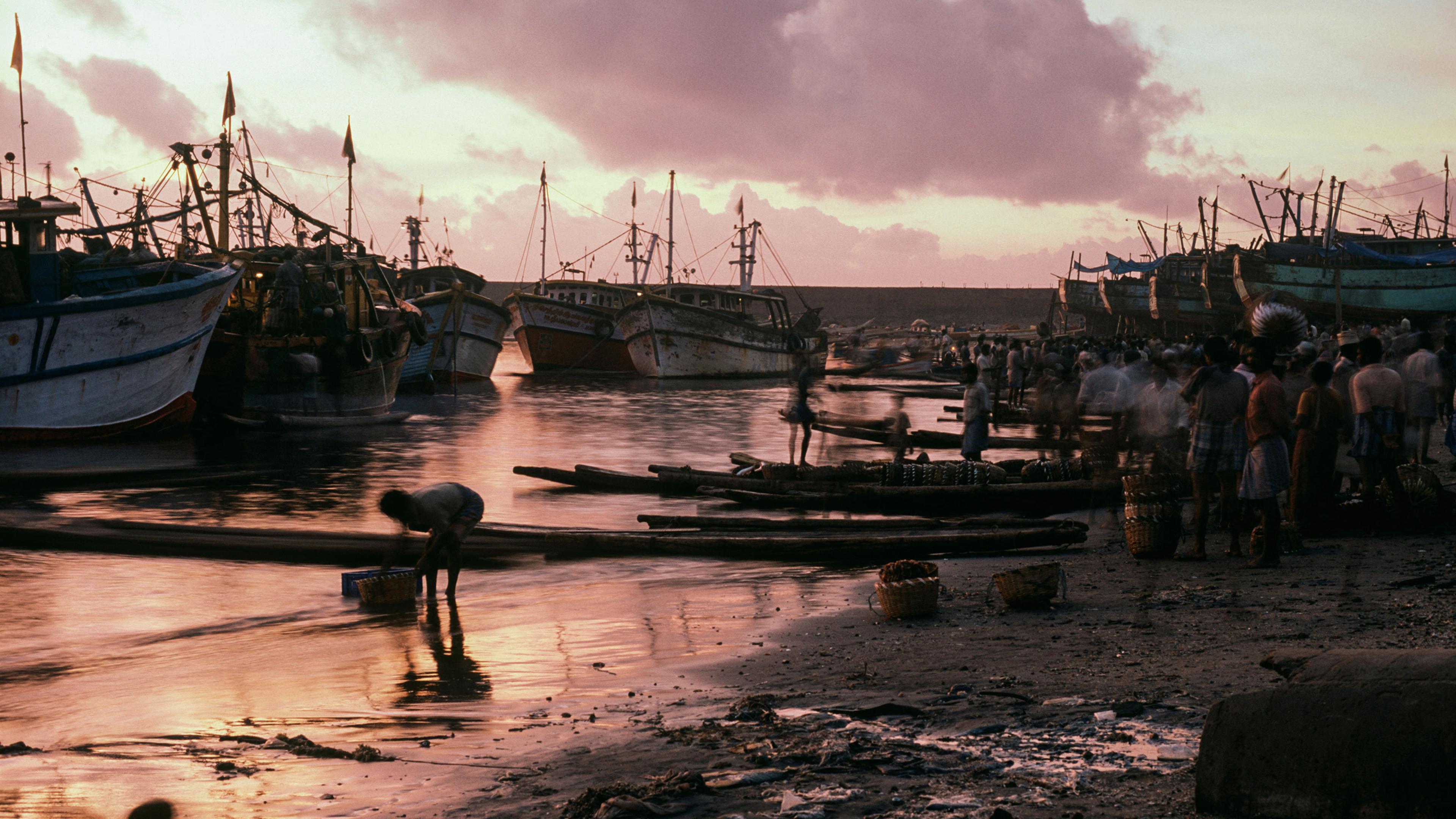
I was 13 the first time I’d gone with my father into the deep sea. ‘Don’t fear the ocean,’ he told me. ‘The sea is your mother; she will always protect you.’ We caught a shark that day too. As far back as we can remember, the men in our family have hunted sharks. Most of the shark hunting in India takes place in Thoothoor. In my father’s time, there were no motorboats; everyone made their own kattumaram by tying together wooden logs, depending on the wind and the stars for navigation. It’s easier now: we have speed engines, GPS and satellite phones. I have lived through both eras.
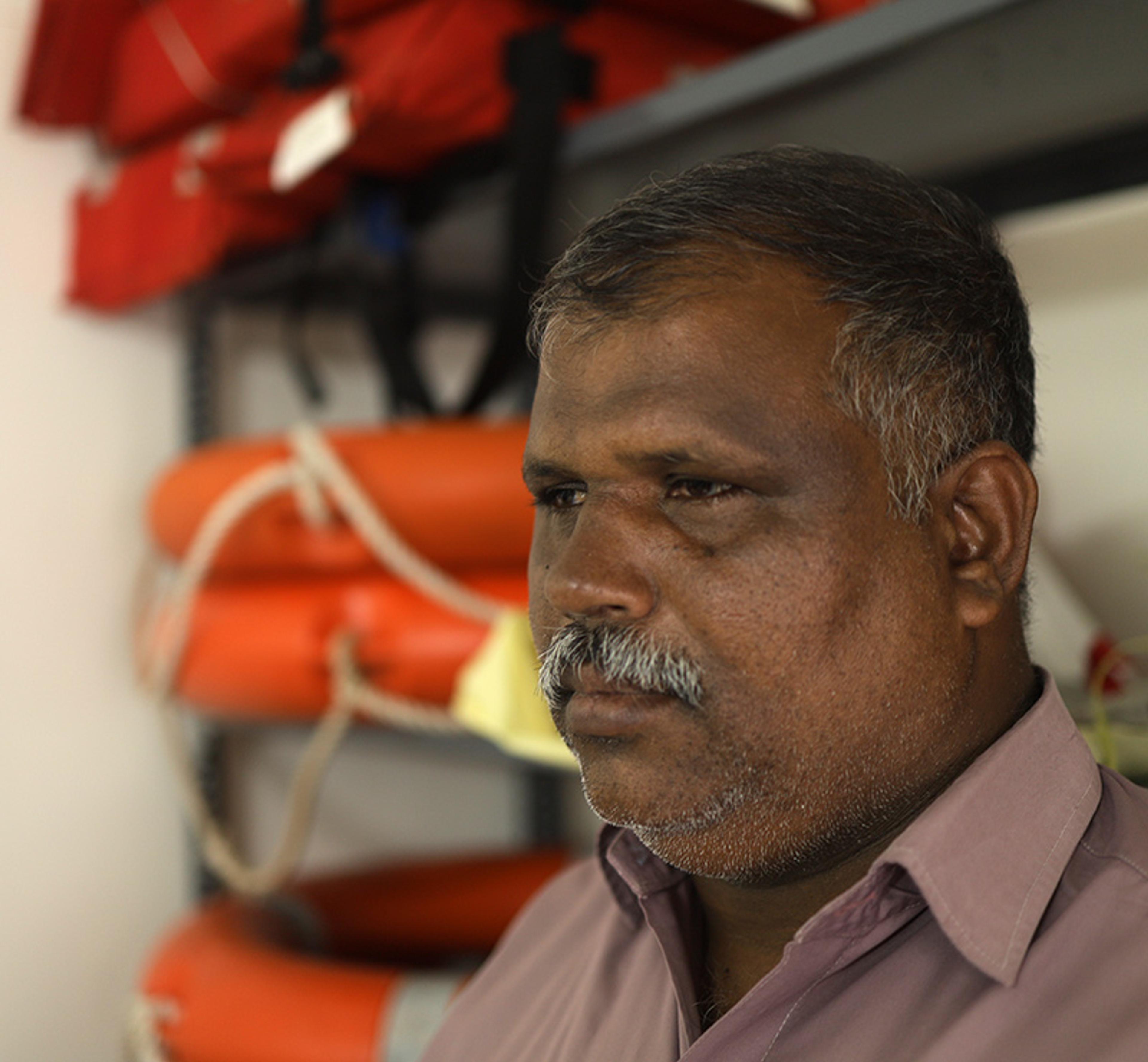
Julius Kaspar. Photo supplied to the author
Not that innovation can always guarantee protection. Once I was stuck at sea for three nights, whipped around by a cyclone. It was late 2017; I’d just bought a new boat. Ten of us were out for a regular night of deep-sea fishing when it hit. At first, we thought it was just another storm and would pass. But it became only more vicious. We had enough food but that was the least of our concerns. It seemed like our boat would capsize any moment. The waves lashed at us mercilessly; our satellite phones stopped working. We were all expert fishers, so we relied on our skills. And we prayed. When you’re a fisher, it’s hard not to be spiritual. But I’d never had to pray like that ever before.
On the fourth day, we made it back ashore without any casualties. Our relief was short-lived: many other boats hadn’t been as fortunate. There were storms before the Ockhi cyclone too, but none as devastating; even the 2004 tsunami didn’t seem to affect us this badly. Many families became homeless. But that’s nothing compared to loss of life, is it? We lost around 80 fishers to Ockhi, many of them men I knew well. Could it have been avoided if we had been warned in time by the government? I suppose it’s pointless reflecting on the what-ifs now.
The fingers of a fisher are like the eyes of a fish. What the fish sees, we feel in our fingers. The shark we hunt the most here is kaakka sravu, the requiem shark. Some decades ago, in 2001 or 2002, the central government in India banned the removal of 60 marine species, including all types of sharks. This was a huge blow for us in Thoothoor: shark fishing is our livelihood, and it is also our way of life. Some 50 of us took the train to New Delhi, more than 1,700 miles away, to protest the ban. We were there for nearly a month and eventually met the environment minister to plead our case. Scientific experts backed us – our traditional hunting methods were not as harmful to the shark population as trawler fishing, they agreed, and certainly not to the endangered ones, which we’ve never hunted historically. Besides, they argued, keeping the shark population in check was imperative for the sustenance of other marine organisms that sharks fed on: dolphins, crabs, lobsters and sea turtles, as well as smaller fish like skipjack tuna and mackerel.
Eventually, the government settled on a middle ground by bringing a dozen or so sharks under the protected species act, while allowing the fishing of the rest.
The kaakka sravu is not that large, no more than 10 to 12 feet in length. The largest shark I ever caught was much larger, weighing around 700 kg. Sharks get attracted to the smell of fresh blood, so we use other freshly caught fish as bait on the hook. Earlier, we used dolphins, but they became a protected species, so we no longer catch them. Before we catch a shark, we observe it the first, second, third time it comes around. Moonnu adi kadathi, marking three times, is what we call this stage. We usually attempt to trap it the fourth time it circles back. It sounds swift and uneventful, but it can take up to five or six hours. When it is on the hook, the shark struggles violently to get free. We hit it on the head, sharp blows with a hunk of wood, to weaken it.
Once, I was reeling in a shark that thrashed so frantically my hand got caught in its teeth. It tore up my wrist. Another time, my foot was seriously injured. I have about half a dozen such souvenirs on my body. My father, who passed away nine years ago at the age of 86, had many dangerous encounters at sea, more than I have had. Once, a katta komban, swordfish, pierced his thigh.
Sometimes, even the fisheries officials don’t know whether what we’ve caught is banned or not
There’s a spot just off the Kanyakumari coast that we call a ‘shark bank’ – this is one of the main areas where we fish. When I was younger, I would sail out to other coasts with my group, towards Oman and Madagascar and Diego Garcia. But maritime laws have become stricter, so we don’t do that anymore. Others still do, and get arrested. When we return to land, merchants are waiting for us. They buy the catch, have it cut into pieces right away and stored as salted meat. The fins used to be in high demand, mostly in foreign markets but now there’s an export ban. So we either discard them or make soup for local events. Most of the shark meat goes to the neighbouring state of Kerala – ironically, in our own state of Tamil Nadu shark meat isn’t as popular commercially. It’s tough, almost rubbery – an acquired taste. We eat it regularly, though.
Every now and then, officials from the fisheries department will charge one of us for catching a protected species. The thing is, it’s practically impossible to distinguish most sharks while hunting. Only after we catch and haul it on board do we see what the species is. By then, it’s usually too late – there’s no point releasing it back into the ocean. Some are certainly easier to spot and avoid: the whale shark, for example, because of its size and spotted hide. Since it’s a Schedule I protected species in India, we are careful never to catch it. But sometimes, even the fisheries officials don’t know whether what we’ve caught is banned or not – only an expert from the Central Marine Fisheries Research Institute can do so. Whenever such arrests happen, our union leaders intervene. A lot of back-and-forth ensues, and, usually, the fishers are let off with a heavy fine. A couple of years ago, more species were included in the protected list.
This way of life feels like a losing battle. Slowly, our communities have shifted focus from sharks to other fish: tuna fishing is becoming more prevalent these days. But the population of all types of fish, not just sharks, is declining. Ironically, artisanal fishers like us are the most affected even though our traditional methods contribute the least to this decline. Practices like light fishing, where trawlers use high-power artificial lights to aggregate schools of fish before catching them, and the use of closely knitted fishing nets, both of which are banned by the government – these are what cause overfishing, and contribute to the destruction of our marine resources. Heavy propellers in boats, the dredging of the coast for minerals and the dumping of industrial waste into the ocean are slowly throttling reefs, which are crucial food resources for all types of fish.
Migrants from other districts and states come to Thoothoor to learn the shark trade from us, but the children of local fishers mostly haven’t taken this up as a livelihood. I guess we, too, are a declining species. I’ve often wondered how our ancestors decided to become shark hunters – is there some ancient origin story? I asked my father when I was younger, but he wasn’t sure either. One theory I’ve heard is that hunting a shark is a symbol of strength. The toughest are those who hunt the largest and most dangerous prey, which for fishers are sharks. Maybe our forefathers just wanted to be the strongest of all. I have three sons: two are graduates; the third is currently in college. I know they won’t continue in this profession, and I’m fine with that. It’s too risky, too uncertain. Lately, I’ve been contemplating taking out life insurance. I haven’t done that yet.