When I was six, I met my sister for the first time in a dim foster agency meeting room. We had been separated by the system: I lived with one foster family, while she moved from home to home, sometimes with relatives, sometimes in temporary foster placements. I didn’t know what she would look like, only her name.
Several days before the meeting, my social worker, Barbara – whom I secretly called Barbie because of her long blonde hair – took me to lunch. Sometimes, over plates of pasta, she would ask whether I wanted to stay with my foster parents, as if I were deciding their fate. This day was different: she wanted to let me know my sister might join our foster family and now, in a dark-panelled room, the lights low and my legs swinging high above the scratchy chairs, I waited for her to arrive.
I didn’t know what to expect. Would she stare at me? Cry? Ignore me? Hug me? She was my sister, but she didn’t know me. Then the door opened, and there she was, seven years old, two perfect braids framing her face, her small hand clutching a box of crayons.
‘Want to colour?’ she asked.
I was surprised by this small wide-eyed girl whose sweetness made my shoulders loosen. In that instant, she stopped being just a name I had been told and became my sister.
I gripped the periwinkle crayon, my favourite. The colour felt rare to me, not like ordinary reds and blues that filled every box. Periwinkle was a shade you had to notice rather than one that demanded attention. As I pressed it to the page, the wax slid smooth beneath my hand. My sister and I shared the book, each of us claiming a page. She bent her head close to her side, concentrating, while I filled in the thick black lines on mine. Every so often, we looked up at each other, as if checking to make sure the other was still there.
Barbara sat nearby, leaning forward, her arms crossed, her long blonde hair spilling over her shoulder. She smelled faintly of perfume, a scent that seemed expensive and adult, foreign to the world of children’s crayons and scratchy agency carpet. Her gaze was steady, kind but never quite warm. I felt studied more than encouraged, as if she were waiting to see what this colouring session would reveal about me.
My sister’s white socks stayed perfectly taut at her calves, not sagging the way mine always seemed to. Her dress was simple, plain compared to my own. I wanted to reach for her hand, to let her know she wasn’t alone.
That rhythm of children coming and going was just part of life
What I didn’t know at the time was the cruelty she’d already endured in her short life – that she’d been ignored in her foster home, that she didn’t have warm meals or know what it felt like to be loved. Even at six, I remember wanting to protect her, to give her the thing I already had: a home.
Not long after, she began visiting on weekends. Our house was always full of kids back then. My parents were foster parents, paid by the county to take in children who needed a place to stay. Some stayed a few days, others for months, some for years, and then they would be gone. That rhythm of children coming and going was just part of life.
I had a playmate I called Bam Bam, a little boy with huge blue eyes and unruly blond hair. One day he just vanished. His toy cars sat abandoned in the corner, dust gathering in their plastic grooves. No one had the heart to move them. Others disappeared too: the girl with a pink hair ribbon who used to share my dolls, and the older boy who spoke of magical lions as he read to me at night.
My sister and I were different. Our foster parents couldn’t have biological children of their own, and after years of hoping for a child to call theirs, they wanted to build a family: that was us.
Our canopy beds were high off the ground, draped in lace that fell like veils. We would climb into those beds, bouncing on the mattresses, squealing with laughter until we settled down.
Sometimes, before sleep, I would peek through the lace to see her still curled beneath her covers. I had nightmares she might be kidnapped, her bed empty like the others before her. Only when I heard her breathing could I close my eyes.
In the mornings, the milkman delivered bottles in a metal crate, a sheen of dew still on the glass from dawn – and my sister was still there. The sharp roar of the can opener was my mother’s daily companion, turning canned goods into our meals. She had grown up during the Depression and never wasted anything. She saved jars, mended clothes, and kept her needles and thread in a round cookie tin left over from Christmas, still bright with its holiday design. The house smelled of milk and baby formula, of oatmeal bubbling on the stove. At the breakfast table, the clatter of dishes mixed with high-pitched laughter and cries. Babies with crumbs on their cheeks banged spoons against trays. Toddlers swung their legs from highchairs. We children developed our own language, part play and part survival, in the cacophony of it all.
My sister and I grew up in the laughter and warmth of that house, always the ones who stayed, though our adoption process was not easy. My father, a Second World War veteran, dragged an oxygen tank everywhere he went. The tank with its jellyfish-like tentacles would snake across the green shag carpet, catching under chair legs and rugs. We children learned to lift our feet cautiously, careful not to trip. The house smelled of Vicks, that sharp menthol clinging to his shirts, filling every corner. He coughed often, but when he laughed, I felt safe. Social workers questioned whether parents in their 50s, with illness shadowing the house, could raise children. I heard their voices low in the kitchen, urgent whispers that made me grip the table edge.
But my parents persisted.
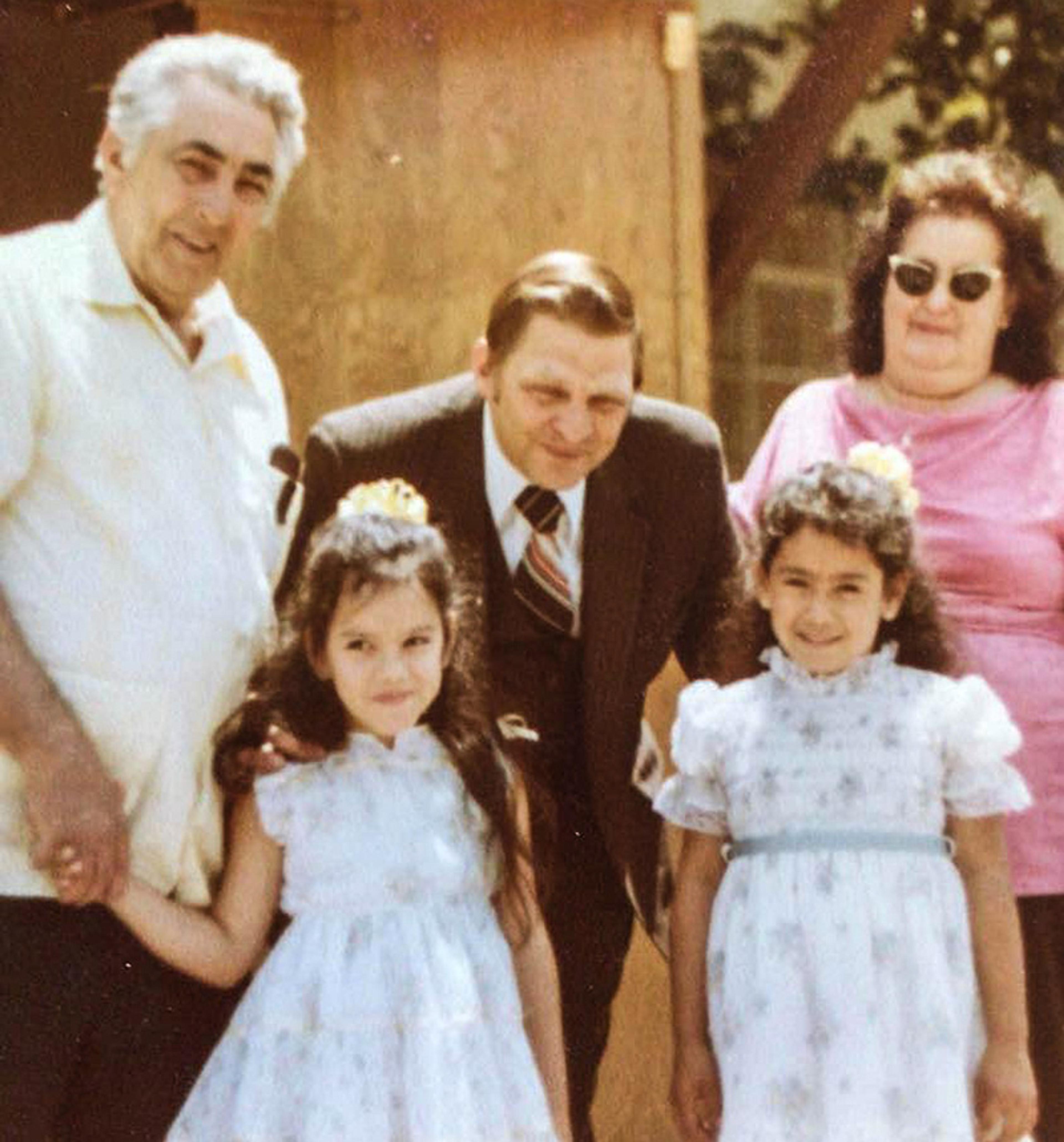
The author and her sister on their adoption day in Los Angeles in 1980
Before our adoption was finalised, I still feared that my sister would disappear one day like the other children who had lived in our home, her usual chair empty at the breakfast table, her bed empty in our shared bedroom. I would also shudder at my father’s coughing, thinking that it could mean something worse – an omen that we could all be forced out of our home. What would happen if his cancer came back? How long did we really have together as a family?
Would my sister and I be abandoned again?
As if in response, our mother bought us matching outfits. In photographs we’re giggling, our skirts puffed out like cupcakes. Our mother, who had grown up with only three changes of clothes, loved to dress us up like princesses. Sometimes I felt like we were on display, and I felt proud and shy about it at the same time. The dresses always matched in style but were usually in different colours, as if to affirm our bond while reminding us that we were still two distinct people.
We grew accustomed to these labels, but it didn’t matter to us too much because we had each other
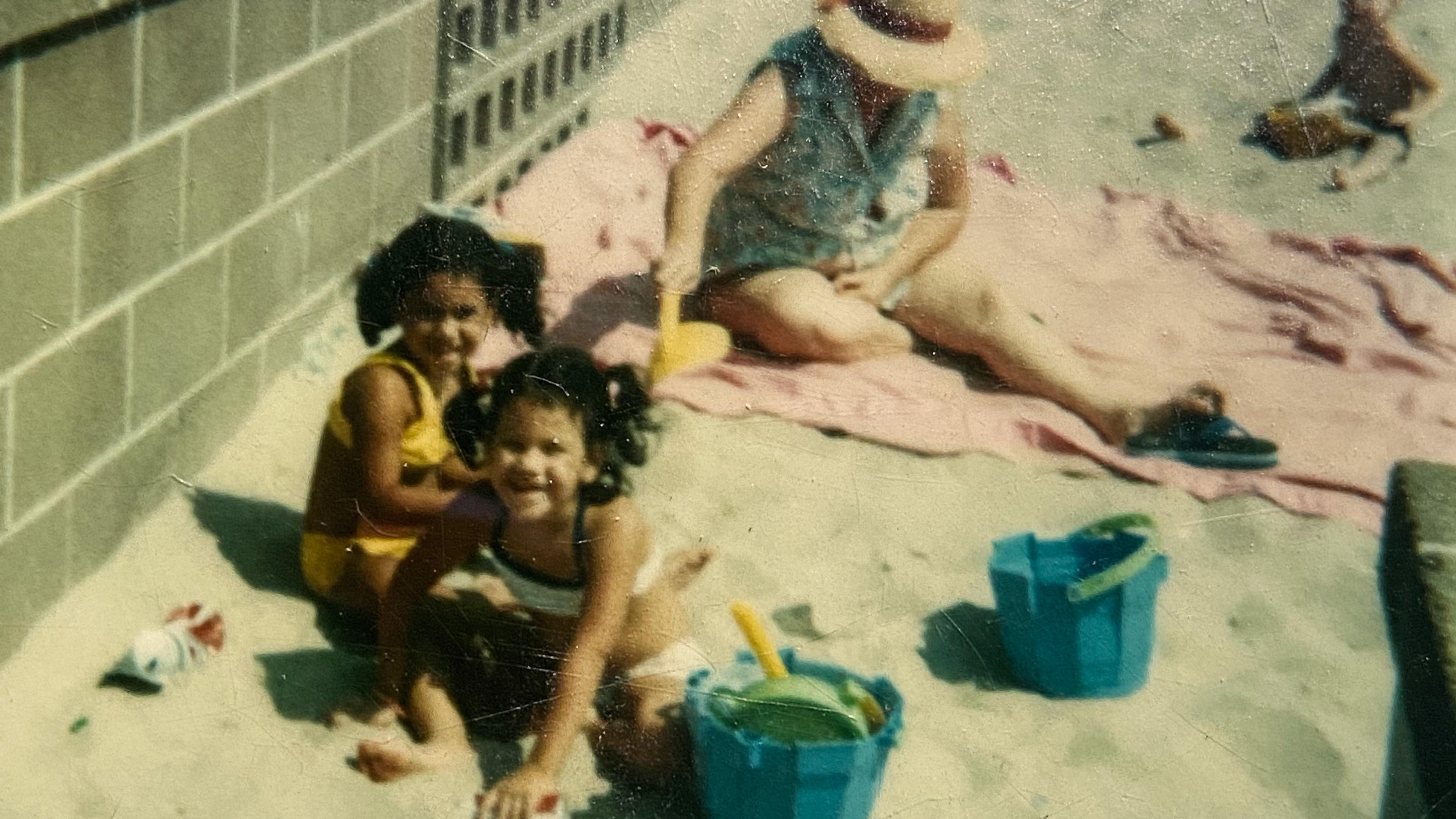
We often assumed the role of little mothers ourselves, helping to feed infants in our care. We were accustomed to sharing. Eventually, we moved from our bedroom into the family den to make room for more children. We also loved our trips in the family RV, frequently travelling up and down the California coast along Route 101. Many of our childhood photos are of us at the beach. We would play all day, planting ourselves into the deep sand, the Malibu cliffs pressed against us, with our brightly coloured pails, digging and shaping new worlds where adults were forbidden. Adults, we decided, could not understand the fragile logic of castles and moats and seashell bridges. The ocean threatened to wash it all away, but that only meant we could start again. At night we especially loved roasting marshmallows, waiting patiently – or not so patiently – as the sugar browned and bubbled. The crackle of the fire mixed with the rush of waves, and when I bit into the sticky sweetness, it felt like magic, as if the world belonged only to us.
My father died when I was 14, the oxygen tank stopped rolling across the floors, and our house didn’t smell like Vicks anymore. A year later, my brother – my adoptive mother’s biological son from a prior marriage, whom I loved as if he were my own sibling – was killed in an accident. After he died, my mother was never the same; sorrow and grief engulfed our house like flames, burning through everything we once knew as normal.
As we got older, we took different paths. My sister left first for college. When I was 18, I left home for a Broadway theatre internship in New York City. My sister was not there to say goodbye, but she would send me letters – her handwriting seemed to wrap all the folds in the paper together as if the words needed guarding. I would unwrap the Scotch tape seal carefully, peeling it back even though it clung stubbornly. Each letter reminded me I mattered to someone.
Our adoptive mother died when I was 28, her memories of our first meeting slowly fading away due to Alzheimer’s. As we grew older, family became even more complicated. Without our parents, some relatives embraced us, while others labelled us ‘the adopted children’ or ‘the foster kids’, as if to make us less than. We grew accustomed to these labels, but it didn’t matter to us too much because we had each other.
My sister and I talk often, leaning on one another through life’s shifts, marriages, moves, illnesses, and moments of joy. Whenever I feel alone in the world, my mind always returns to that first day in the meeting room: the dark-panelled walls, the carpet under my feet, the hum of adult voices, the nervousness that hung in the air, and then her, my sister with her box of crayons, who asked: ‘Want to colour?’
From that day on, we have never let go.