Think of the people whom you trust. Your immediate family? Hope so. Friends? Certainly. Does your circle of trust extend much beyond that? You might say no, not really. But, in reality, we all trust people and institutions all the time. The bus or train driver who gets us to work; the restaurant that makes our food; our banks. The digital behemoth that stores our photos; our pharmacists, elevator repairmen, pilots, and so on. The guy who might sell us something illegal on a Friday night – and perhaps especially him, given that no-one is regulating his products.
We all trust in people we have never seen, and businesses whose workings we cannot begin to understand. In the course of a day, we will trust more of them than our ancestors could have imagined. For them, there were only two kinds of trust: the interpersonal, where certain people were trustworthy and others were not; and trust in God, or gods.
We are different people now, and the vast advances we have made in the past few hundred years – in lifespan, health, wealth, equality and opportunity – are largely down to our willingness to trust institutions. Medicines are developed by scientists and manufactured by pharmaceutical companies, but without trust we would never have been able to trial them. Now that so many of us say that we mistrust or distrust things like Big Pharma and the government, we need to think about what the consequences of a breakdown in institutional trust would be. This elusive, slippery concept is not just a nice thing to have: it is vital to every aspect of 21st-century life.
Trust is the glue that modern nation-states require. It enables people to lend money and buy goods made by workers they have never met, earn interest from a bank, and travel in machines whose mechanics they do not grasp. Democracy brought the opportunity for men, and later women, to decide whether they trusted the people who wanted to lead them. An individual could lead a nation not because their ancestors had, or because they had seized power through violence or cunning, but because of the trust that millions of citizens had placed in them.
Perhaps the most rudimentary or crude institution by which to measure trust is the police. Let’s take an example from 19th-century European history. In the 19th century, the Metropolitan Police in London enjoyed a degree of public confidence that did not reflect the widespread corruption and malpractice in the force.
By admitting some malpractice did exist, the Met police established a reputation for probity
It was a different story in Berlin, where the press and Left-wing politicians constantly complained about the violence and rudeness of the Schutzmannschaft. So what did the forces do differently? Why did one enjoy a reputation for probity while the other was loathed and resented?
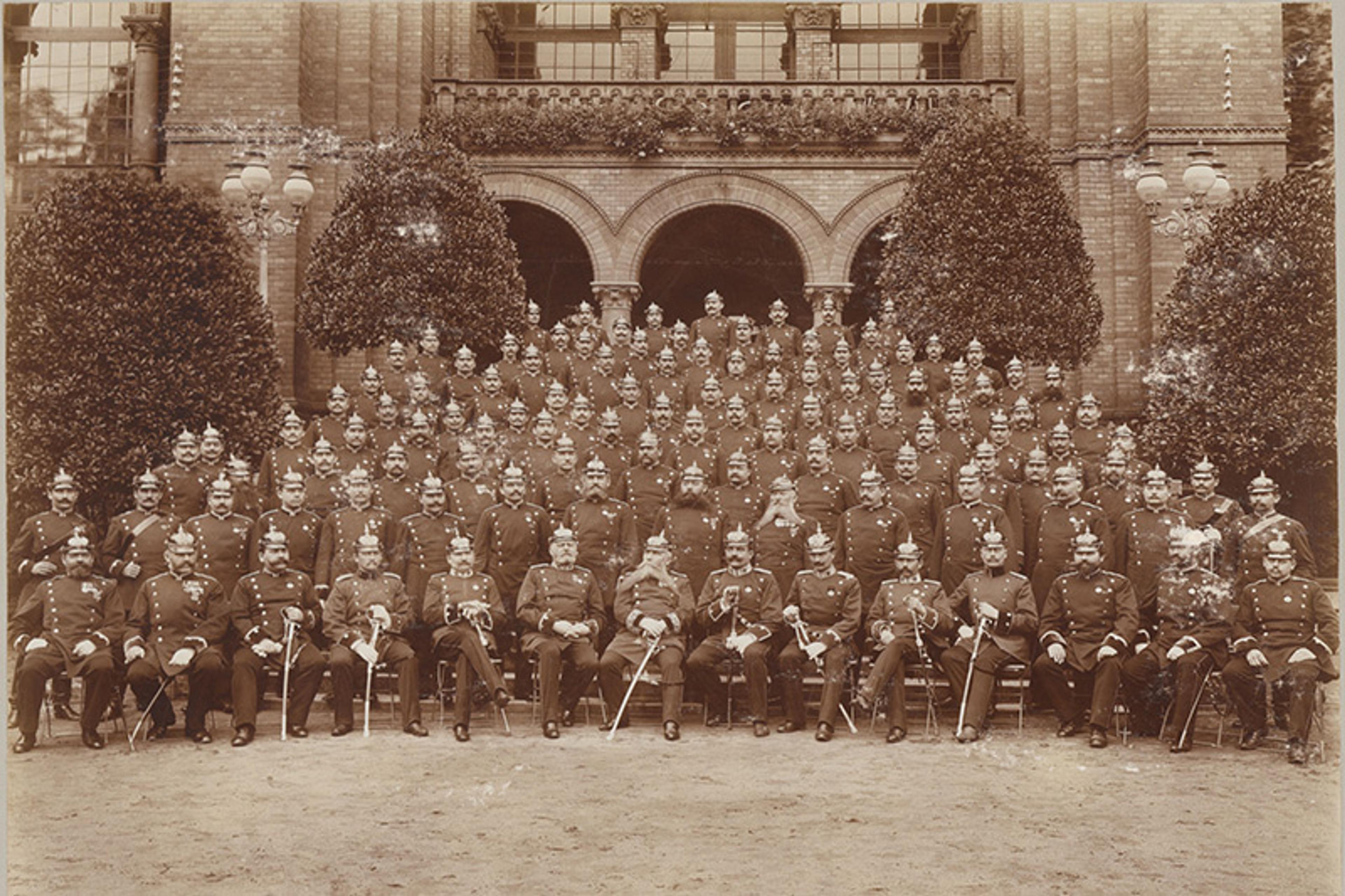
The Schutzmannschaft of Charlottenburg in Berlin, Germany, c1899. Photo courtesy the German Digital Museum
According to the historian Anja Johansen, the Londoners adopted a strategy of what’s been called ‘winning by appearing to lose’. What this meant was that the Met police handled complaints courteously, identified some transgressions and punished them. In contrast, the Prussians made it extremely difficult to file complaints and then conducted any internal investigations in secret. Complaints against the Met often went nowhere: the word of a policeman was much more likely to be believed than that of a civilian. But the process was deliberately civil and tried to appear reasonable. It helped that the press – which, certainly in Britain, often enjoys a mutually beneficial relationship with the police – was supportive. Newspapers contrasted the endemic violence and corruption of European forces with the approachability of a British policeman. Any bad apples, the Met insisted, would be identified and thrown out of the force.
The Berliners tried to stop criticism completely – or, failing that, to shut it down. Sacking a Berlin officer was almost impossible.
By admitting some malpractice did exist, the Met established a reputation for probity. The appearance of an orderly society helped commerce to thrive and the police in London to enjoy higher levels of public trust than in Berlin, even if that reputation was not necessarily accurate. Secrecy sows suspicion, but letting even a little light into the workings of the police produces high rewards in trust.
Most of our modern ways of trusting rest on layers and layers of institutions built to craft and teach and enforce all sorts of regulations and laws, not just the police but all sorts of regulatory and professional institutions. Putting our trust in bodies that can take on that burden liberates us to do extraordinary things.
Take aviation. In 1956, more and more Americans were flying on the new planes built by Lockheed, Boeing and Douglas. They trusted the pioneering technology of these US firms and the airlines that flew them. They were excited by the thrill of flying and the possibilities of travelling hundreds of miles in an hour.
Then, in June 1956, a TWA Super Constellation and a United DC-7 disappeared over the Grand Canyon. No one witnessed the collision and there was no radar. Only when the wreckage of the planes was found could investigators piece together what had happened. It emerged that neither plane had been under air traffic control, and the revelation of how little supervision there was of the skies led to the creation of a single agency that had authority over all US airspace. Accidents became rarer, and public trust in aviation returned.
By acting on the failings that led to this terrible mistake, the NIH was able to win back public trust
It’s also true that simply creating the institutions that enforce laws and regulations is just a start. Those organisations then have to show they are competent and effective, cracking down on bad practice and things that endanger the public. The year before the Grand Canyon crash, the first polio vaccine was licensed in the US. Just 13 days later, one of the recipients of a jab manufactured by Cutter Laboratories fell ill with polio; the following day, there were five more cases. Almost immediately, the Laboratory of Biologics Control ordered a recall of all Cutter vaccines and found that live polio virus had survived in two of the batches.
For the 380,000 children unwittingly injected with a terrible disease, it was an appalling betrayal of trust. More than 200,000 caught polio, nearly 200 were paralysed, and 10 died. Yet, by identifying and acting on the failings that led to this terrible mistake, and putting a new regulatory framework in place, the National Institute of Health was able to win back public trust. The vaccination programme resumed in the autumn of 1955.
Obviously, the story of institutional trust is more complicated than this. Sometimes the trust that the public invests in an organisation is not justified.
We all agree that confidence in institutions is in principle good, but what if the institution is not worthy of our trust? Should we criticise corruption and demand reform, and at what point should a society stop being so trusting? The answer is not self-evident.
There are many examples of grossly dysfunctional institutions that insisted on their integrity. One example is the way that the National Health Service in the UK handled the scandal of contaminated blood transfusions during the 1970s and ’80s. For years, the NHS gave haemophiliacs blood infected with hepatitis C or HIV, even though public health officials privately warned of the risk of contamination. Records were destroyed and no one has yet been held accountable. Private institutions face the same challenges with trust and wrongdoing. For years, the Roman Catholic Church and the Boy Scouts of America suppressed knowledge of paedophilia in their ranks because of the terrible reputational damage. They were right – but covering it up made it even worse.
It is becoming harder for institutions like the police and health authorities to hide their failings. Anyone can film a police assault on a smartphone. The job of holding them to account used to be done, imperfectly, by the press. Now, social media enables almost anyone to publish about malpractice. There are many things to like about the democratic aspect of social media, but it is also bound to corrode institutional trust. Journalists have many faults, but they usually draw on more than one source, and at least request a comment from the subject of their stories. On social media, one-sided accounts, a partial grasp of complex issues and the selective use of data can quickly paint a damning and misleading picture.
Institutions cannot (and should not) withhold information in the hope of avoiding scrutiny
In 2002, 46 per cent of Americans told pollsters they trust key institutions. In 2024, it is just 22 per cent. In 2002, 59 per cent trusted the police. Today, 45 per cent do. These judgments might be correct: schools may be worse, and the police may be more corrupt than they used to be. But it is at least as likely that people are simply more aware of these institutions’ failings.
What can be done? In an open society, the genie cannot go back in the bottle. In a data-driven world, institutions cannot (and should not) withhold information in the hope of avoiding scrutiny. No democracy should try to stop citizens from exposing wrongdoing. But if we do not want to live in societies like that, how can we stop the relentless erosion of institutional trust?
A first step might be to stop assuming that greater transparency leads to more trust. In the short term, it may not. Sometimes, the very act of opening your workings to public scrutiny turns out to be corrosive.
A second step would be to avoid writing off flawed institutions as beyond redemption. Defunding the police or cutting funding to universities might feel like appropriate responses to different people in anger but positive reform is often superior to simply abolishing an institution.
I could have chosen not to take this risk. But the price of distrust could be very high
A third step is to acknowledge that trust is not perfectly grounded in reality. To trust is not to know. Trust is a feeling – not one based on ignorance, but on a mixture of personal experience, anecdote, reporting and data. In a quantified world, this is uncomfortable.
Last year, I swallowed eight chemotherapy tablets containing a powerful compound that interferes with DNA synthesis and repair. It’s a drug normally prescribed to treat cancer and it is now being used to slow down the progress of multiple sclerosis. The side-effects were, for me, minimal. But no one can be sure what effect it may have further down the line. What made me take the tablets? The fear of disability, of course; a cursory reading of the research papers on the drug; information from MS charities; and trust in the doctor who has treated me for the past seven years.
I could have chosen not to take this risk. But the price of distrust could be very high. A degree of uncertainty seemed worse than the prospect of letting the disease run its course. These decisions, and the ability to make them at all, are what makes us modern. Yet they rely on sophisticated networks of trust – the institutions that some charismatic individuals now promise to sweep away because they are deemed to be rotten.
Societies must have a healthy scepticism about their institutions. They need to be held to account. But politicians should be wary of tearing up the fragile tissue of institutional trust. It is easy to destroy, and very hard to get back.