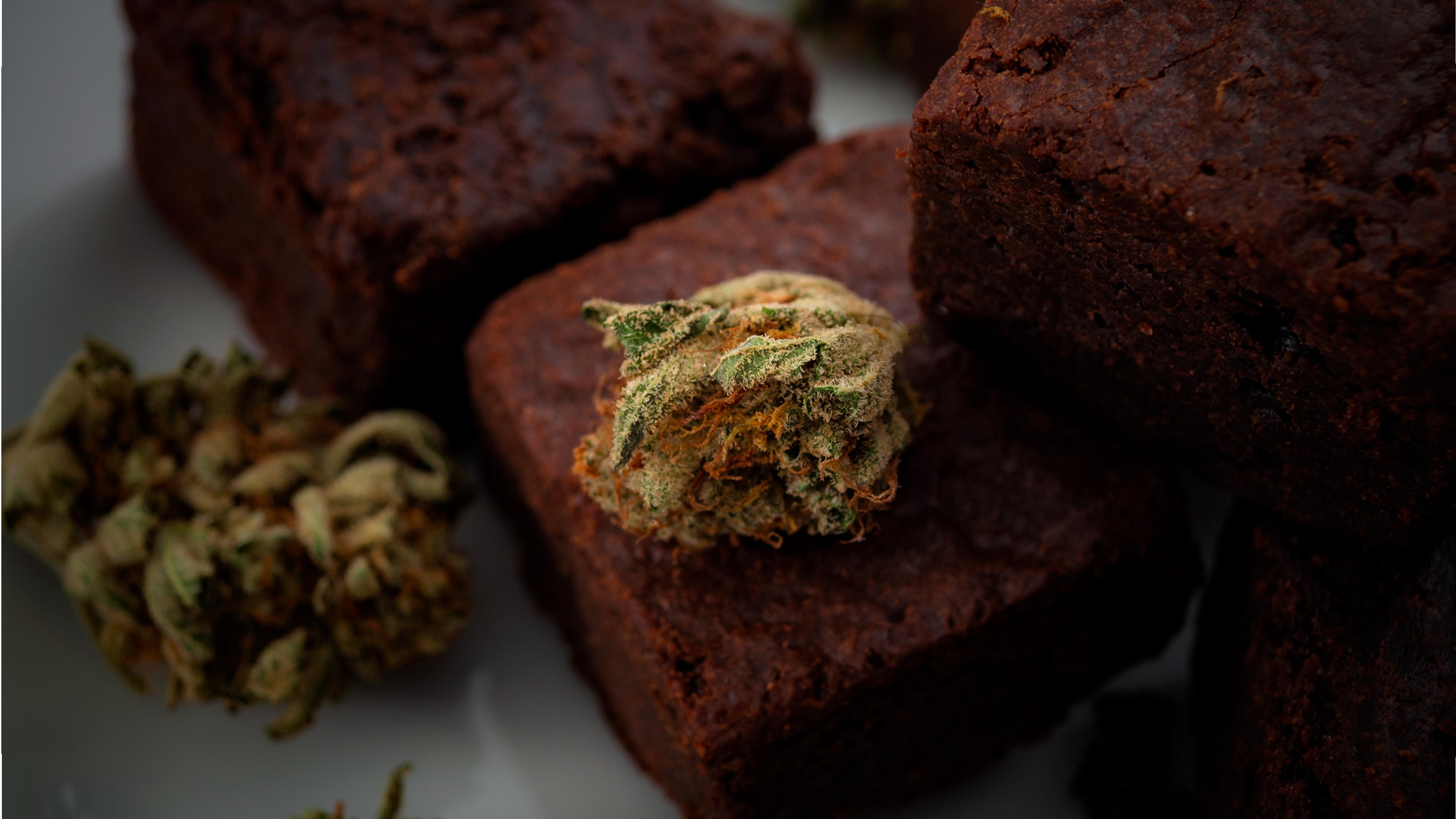
It was Halloween night in our cramped one-bedroom apartment. The Cloud Atlas theme played on repeat from our HomePod as my wife and I hovered over the kitchen counter, studying a greenish, meteor-like lump with a strange smell – a piece of weed-infused chocolate. We split it in half and each took a piece. It was our first time trying edibles, and we made the classic rookie mistake of taking too much.
Up on the third floor, we wouldn’t get trick-or-treaters, so we settled into our velvet loveseat and waited. Minutes later, my wife blurted: ‘It’s starting,’ wearing a look I’d never seen – pure panic. My chest tightened and my heart rate spiked instantly. I tried slow, steady breaths to calm myself, but that barely made a dent.
Then, it hit me too – a surge of terror so physical it felt like tiny bugs were crawling under my skin. Nausea set in. My vision narrowed and I felt trapped in my head with no escape. When I checked our microwave clock, I couldn’t believe it had been less than a minute. Somehow, time was stretching and collapsing all at once.
My wife drifted into the bedroom, then out, then in again. I could barely process what she was doing. I felt as if I was being tortured, trapped in eternity. ‘It’s OK. It’ll end soon,’ I told myself. I stayed on the loveseat, trying to ride it out – to meditate my way through it, hoping the feeling would pass.
Every time I managed to soothe myself, my wife would reappear from the bedroom and ask: ‘Are we going to be OK? Should we call 911?’
I reassured her: ‘It’s OK. We’ll be OK.’ But each time another wave slammed into me, and I found myself in a weird, repetitive loop – going from the kitchen to the bathroom, trying to throw up, grabbing a tissue, then back to the kitchen. I was powerless, certain that there was nothing I could do to make this hell stop. Eventually, we both ended up in the bedroom, lying under a blanket and holding each other, convinced we were slipping away.
A couple of months before that Halloween night, my sister died by suicide. I remember the day it happened – the missed calls from my mom, who my sister was living with. Eventually, I saw a text saying: ‘A. is gone.’ I called my mom back from my office. Her voice still haunts me – the way she described my sister’s death. She had hanged herself. By the time I called, the police were already there.
My sister had always struggled. She lived with borderline personality disorder, major depressive disorder, body dysmorphic disorder – labels that never fully captured her pain. Perhaps I was biased, since I’d lived with her most of my life, but even after seeing many clients in my therapy profession, she felt like the hardest case (not that I was treating her). For years, she had talked about wanting to die. There were good days and bad days, good months and bad months, good years and not-so-good ones. But the last year had been especially rough.
As devastated as I was over my sister’s death, it was the weed overdose that sent me spiralling to a new low
I can’t fathom how miserable my sister must have felt that she wanted to escape life. I can’t imagine how difficult it was for my mom to witness her child’s years of struggle – and then to be the one to find her. I truly believed my sister would never actually go through with it, even after hearing her say hundreds of times that she wanted to die. And yet, the unthinkable had happened. I froze, nearly hyperventilating. I kept saying: ‘What?’ over and over again, trying to take in what I’d just heard.
It was, and still is, one of the most painful experiences I’ve ever endured. I was overwhelmed with sadness, regret and guilt. Despite her struggles, my sister and I were very close. She was the reason I became a therapist. I felt like a failure because I could not save her in the end.
But as devastated as I was over the death of my sister, it was that overdose of weed that sent me spiralling to a new low.
Six months after that Halloween night, I was lying in bed. My cellphone display said it was past 1 am. While my wife was sleeping peacefully next to me, I found myself replaying my bad trip with an edible. It was as if one part of my brain kept trying to reexperience the pain while another part kept trying to make sure those torturous sensations couldn’t come back.
Then, boom – all of a sudden, I was having another bad trip, this time without any substance. A strange, unpleasant sensation began around my head. Warmth spread from my chest up to my neck. My body felt light, distant and unreal like I was in space, and my tether cord had broken, my air running out. The truth is, my one and only edible weed encounter had been on my mind for months, and I often thought how terrible it would be to go through that again. Now my biggest fear had just come true. I was having a panic attack in my bed. Something changed in me after that moment, biologically or chemically. I could feel it.
I realised I had been using the word fear casually, without ever truly knowing what it felt like. People think of a panic attack as something you either have or don’t, but there is this in-between state where you’re not having a full-blown attack, but you’re still experiencing those same terrifying sensations. The impending doom, the sensation of going crazy – it’s nearly indescribable.
In the wake of my flashback, my mind feared the fear – the terror of it happening anywhere, anytime, and the more I thought about not wanting it to happen, the more it started happening. Just days after my first panic attack, I was sitting in my office, trying to write therapy notes. Sunlight filled the room through the glass wall, but I didn’t feel light. My thoughts were spiralling – I’m going crazy. I’ll have to be institutionalised. I’ll never be the same. A wave of panic started to rise, and I thought about calling 911, convinced that it was the only option, which made me feel even more trapped. Needless to say, I didn’t make the call.
Suddenly, things I never thought twice about became fear-inducing. I was an avid meditator, but now I was afraid to sit and close my eyes. Anything that would remind me of a panic attack scared me. A bodily sensation, a thought, confined spaces like a car or an airplane. Even something as simple as drinking coffee or alcohol, or going to the store or movie theatre, would set me off.
The fear that any bodily change would trigger a panic attack kept me from going there
I remember going to see our first movie since COVID-19 – Top Gun: Maverick. It was a weekend night, and I was already anxious about going. The theatre was dark, and the air felt still. As the movie began with the famous, slow-build theme song, my body reacted before my mind could catch up – temperature rising, heart rate increasing, limbs tingling. I was about to dissociate, float away into darkness. I gripped the armrest to ground myself, unsure if I could sit through two hours.
Knowing almost anything could set me off, I became afraid to process my sister’s passing. I wanted to look at photos and watch old videos; but the fear that any bodily change, even the tightness in my face before tears, would trigger a panic attack kept me from going there. My fear overtook the sadness of my loss.
For months, I dreaded going to sleep. The transition from wakefulness to unconsciousness felt like slipping into another state. Those moments under the edible’s influence had unlocked my capacity to feel things I never knew I could feel, and I questioned if I would ever be normal again.
As a therapist who specialises in anxiety and OCD, I understand what avoidance can do. That is why I tried to be aware whenever there was any urge to avoid, and instead face it. I committed to not changing my day-to-day behaviour. I drank coffee, even though it made my heart race. I drank alcohol socially, despite the buzz. I trained in Brazilian jiu-jitsu, where I was literally choked by partners. I drove, even as my mind warned me of a panic attack. I flew, trapped in the sky. I kept seeing clients, sometimes feeling their anxiety and fears as if they were my own.
I’ve gained a new appreciation for what my clients might be going through. Now I understand how it feels to force yourself to buy a plane ticket, while secretly planning an escape – dreading it for months. I recognise the pull to shy away from altering your consciousness – medication, alcohol, coffee. I know the urge to check for the nearest emergency room. I also know the silent fear that what once felt hellish might return. Whether it’s a panic attack, a health scare, or a depressive episode, I have a deeper empathy for how hard and unliveable life can sometimes be.
I was able to accept that I might have more panic attacks, but that it was OK
I remember conducting an exposure – a kind of therapy that helps people face their fears – with a client whose panic attacks were triggered by driving and crowded places. Driving was part of the exposure, so we drove in his car from my office to a local outdoor mall, known to be crowded, even on a weekday. The mall was huge, with parking lots surrounding it. We parked in front of Target and walked straight inside, moving past the entrance and down the aisles towards the back of the store. The deeper we went, the more anxious he became, until he hesitated, saying he had to turn back. I also felt a jolt of anxiety – his panic felt contagious. I knew from my own experience his brain was telling him to leave, but I also knew that bolting would make it worse long-term. I gently encouraged him to stay. But I was also self-compassionate, because this was a hard moment for me too, balancing my own anxiety while supporting him. We kept doing the exposure.
After a while, I reached a new level of acceptance. I was able to accept that I might have more panic attacks, that this unpleasant thing might stay, but that it was OK. This became the new norm. Acceptance didn’t mean it wouldn’t happen again.
After all this agony, I am glad I went through it. In no way am I saying I’m happy it happened. I’m also not saying: Look at me. Look at how resilient I am. But I did realise, like Viktor Frankl once said, that there can be meaning in suffering.
As for my sister – did I forgive myself? I think I did, or maybe it’s just easier to live that way. Maybe I caught a glimpse of what she was going through, and why she wanted to opt out. At my lowest, I could understand why she chose to leave. My suffering was not the same as hers but, when things were unbearable, I too wanted out. People might think: Oh, in the end, she lost – the same way people talk about losing the battle to cancer, as if you’ve failed if you die. Others might see suicide as selfish, weak, cowardly or even criminal. But, in some ways, she was a warrior. The panic is still here, and so am I.