‘I’m downgrading your autism diagnosis,’ my therapist said. For a moment I thought I’d misheard him. The same clinical psychologist who’d given me that diagnosis a few years earlier was suddenly a talking head, erasing my identity over a Zoom call.
I hadn’t been in Maine long before I scheduled the appointment for autism testing, years before I ever saw him for therapy.
On the ride to his office, the cab driver went on and on about how he had to euthanise his dog for running away whenever he let him off leash. Poor dog. I thought a cup of coffee might help settle the story in my stomach, so I got out at a café, convinced I’d be able to find the address on my own. Of course, I got lost, and the psychologist had to drop everything and get in his car to find me.
Despite the session beginning in his car, the rest of it proceeded smoothly once we got to his office. The testing room was sunny with lots of windows. I could see rows of pine trees blurred by condensation on the glass. After filling out a stack of questionnaires, I was tested on a variety of subjects and questioned about my entire life from birth to present – the usual search for where it all went wrong. (Fortunately, I left out traumatic details like growing up in a neighbourhood where my mother’s friends from the Women’s Auxiliary Guild all had names like Celeste Wooley.)
When the cab driver – thankfully not the same one – arrived to pick me up after the session, the psychologist instructed her to take me directly to the door of my house. Maybe he thought I’d get lost again – even in my own neighbourhood.
Months later, when the report finally arrived, I treated the diagnosis the way someone might treat a long-awaited college acceptance letter. It meant I belonged somewhere – that I was part of a community. I had waited 58 years for a diagnosis so often framed as a ‘male condition’, a misconception that had erased my experience for most of my life. Finally, I had a label that explained the sensory sensitivities, the meltdowns, the why in some social situations I just didn’t fit in. I wore my diagnosis like a badge of honour, a kind of Purple Heart earned from decades spent masking my differences and trying to pass as everyone else.
I’d finally been un-erased, and now, on Zoom, the same therapist wanted to erase me again.
Why?
‘Because you feel empathy. Because you have friends,’ he said.
So, because I cry at the opera, can’t watch films where animals are in danger, and have several friendships that have survived almost half a century, I lose a diagnosis that validates so much of who I am?
After days on Google Scholar, I found an article in Scientific American: ‘People with Autism Read Emotions, Feel Empathy’ (2016). I didn’t even finish the first line before I was on my feet, punching the air. ‘Yes – yes – yes!’ I wanted to run through the streets shouting: ‘F— you’ to every expert who claimed otherwise.
I reached out to the authors – two researchers in the UK. Jennifer Murphy spoke to me while on her way to the train station. Rebecca Brewer stayed late at the office one evening. Both explained a condition called alexithymia and how it’s often mistaken for autism, though the two can overlap. People with alexithymia often struggle to identify and describe their own feelings.
As someone with autism, I understand my emotions. The trouble lies in expressing them.
I feel emotions deeply, but they don’t show in my facial expressions, tone of voice, or body language. When you have only words, it’s like trying to have a phone conversation with only a partial signal. Though people with autism vary widely in how they express (or don’t express) emotion, in my case the feeling is there even if it isn’t visible. Both autism and alexithymia can look similar from the outside, but for different reasons: for many people with autism, the emotion is felt but not shown, while in alexithymia, you can’t express what you don’t understand.
He announced to me and the entire class that I was like a black hole draining everyone’s energy
It’s that disconnect – between what I feel and what I express – that earned me a nickname back in high school. City-As-School, an alternative high school in the heart of downtown Brooklyn, was my last-ditch effort at secondary education before taking the high-school equivalency exam (GED).
It was the fall of 1976. I registered for a poetry course and started my first semester. My uniform? A suede choker with feathers, a Free Bird T-shirt, and a flowing skirt. I was a hippie in a newly emerging punk rock scene, surrounded by mohawks, black Doc Martens, and students wearing safety pins in their ears.
My teacher – Fred Koury, co-founder of City-As-School and revered in obituaries – announced to me and the entire class in a tone that might as well have been broadcast over the school intercom that I was like a black hole draining everyone’s energy. He said everyone agreed. It bothered them that I never smiled.
I felt happy (at least until being compared to a black hole) but, at 16, I didn’t understand that to others it looked like I wasn’t feeling anything at all.
So, in the way close friends turn tragedy into comedy, a student at the school, Walter Joseph Weir, Jr – another outcast, always in a suit and a tie – changed my name from Adrienne to A-Drain. It worked. I laughed then. We still laugh about it 50 years later.
Well, I never did go back to that class. And the next one wasn’t any better. I was earning science credit as a teacher’s assistant in a special-ed class when the teacher asked if I was on antipsychotic medication.
‘No,’ I said.
‘Are you sure?’ she pressed. ‘Your lack of expression is usually caused by antipsychotics.’
The irony is that I was a misfit in a school for misfits, so I dropped out and got my GED.
Two years later, the school’s resident graffiti prophet, Jean-Michel Basquiat, was expelled for throwing a pie in Fred Koury’s face. And I – got pathologised. Basquiat went on to make art history. I got diagnosed with ‘negative schizophrenia’ by a psychiatrist who, many years later, kept sending me Facebook friend requests from multiple accounts. During our sessions he told me my flat affect matched a rare subtype he and his colleagues at Brown were studying – no delusions, no hallucinations, just a monotone voice and a tendency to stare off into space.
He also picked at the scabs on his hands and ate them.
That memory stuck – but what really stayed with me was what he said – that my voice doesn’t convey what I feel inside.
Sometimes it comes out in volume.
Just like my mother, I get louder when I’m excited. As kids, my sister and I were always embarrassed by the force of her voice. Once, when Allison was five, her face turned bright red and she hid under a chair at the beauty parlour because my mother started sobbing – full volume – during Nixon’s resignation speech, while everyone else there was trying not to laugh.
Instead of expressing emotion through tone – I just crank up the volume
As we got older, we realised our voices were just as loud. Sometimes when we were in a public place, my sister would warn me, ‘Your voice is getting louder just like Ma,’ and we’d burst out laughing. We used to chalk it up to being Episcopalian – like a ‘serendipitous’ announcement shouted across the lawn at a meeting of the Daughters of the American Revolution, ushering us closer to the rock-and-roll chicks we became.
But it wasn’t just our upbringing – it was autism. Instead of expressing emotion through tone – I just crank up the volume. I don’t even realise I’m doing it, but it can come off as confrontational.
Once, that volume almost got me arrested. A postal worker called the police and claimed I was yelling. I wasn’t. I was trying to explain something calmly, about a missing package. When I stepped outside, an officer stopped me.
When I started explaining what had happened, he also thought I was yelling at him and ordered me to stop shouting.
‘I’m not yelling,’ I said. ‘I have autism.’
I wonder if anyone else has ever been confronted by the police for having a loud voice.
It’s what the autistic sociologist Damian Milton calls the ‘double empathy problem’ – when two people wired differently, like me and the officer, completely misread each other. Communication flows easily between people of the same neurotype – autistic with autistic, non-autistic with non-autistic.
Sometimes my friend Chye and I, for example, listen to music together, and right in the middle of a song, we just start laughing – a Billy Powell piano solo, Dickey Betts and Duane Allman trading riffs, the epic performance of ‘Soul Sacrifice’ at Woodstock. We never talked about why. We didn’t need to. We were laughing at the brilliance.
Have you ever seen a person without sight look up to the sky and laugh when no one else is laughing? It doesn’t follow conventional social cues. I see it as an atypical response to joy – shaped by a different way of experiencing the world. Maybe they’re picking up on something more intensely in one area because of a difference in another.
One difference for me is a kind of rewiring of the senses called mirror-touch synaesthesia (MTS), a condition where seeing someone touched or hurt creates the same sensation – and sometimes emotion – in the observer’s own body.
About half of all people with MTS are said to be autistic.
The neuroscientist Michael Banissy calls the type I experience mirror pain – when I see someone hurt, I feel it in my own body. It never feels the same twice. It often starts with a rubber band snapping in my solar plexus. My knees buckle. I see spots. Then it expands into a deep emotional current that floods in and won’t let go. I can’t always tell where their feelings end and mine begin.
A cognitive neuroscientist I interviewed, Kalliopi Ioumpa, described MTS as ‘almost the definition of empathy – feeling someone else’s state in one’s own body as if it really were their own.’
Sometimes it’s there long after it’s over – like the incident with the boy on the bicycle.
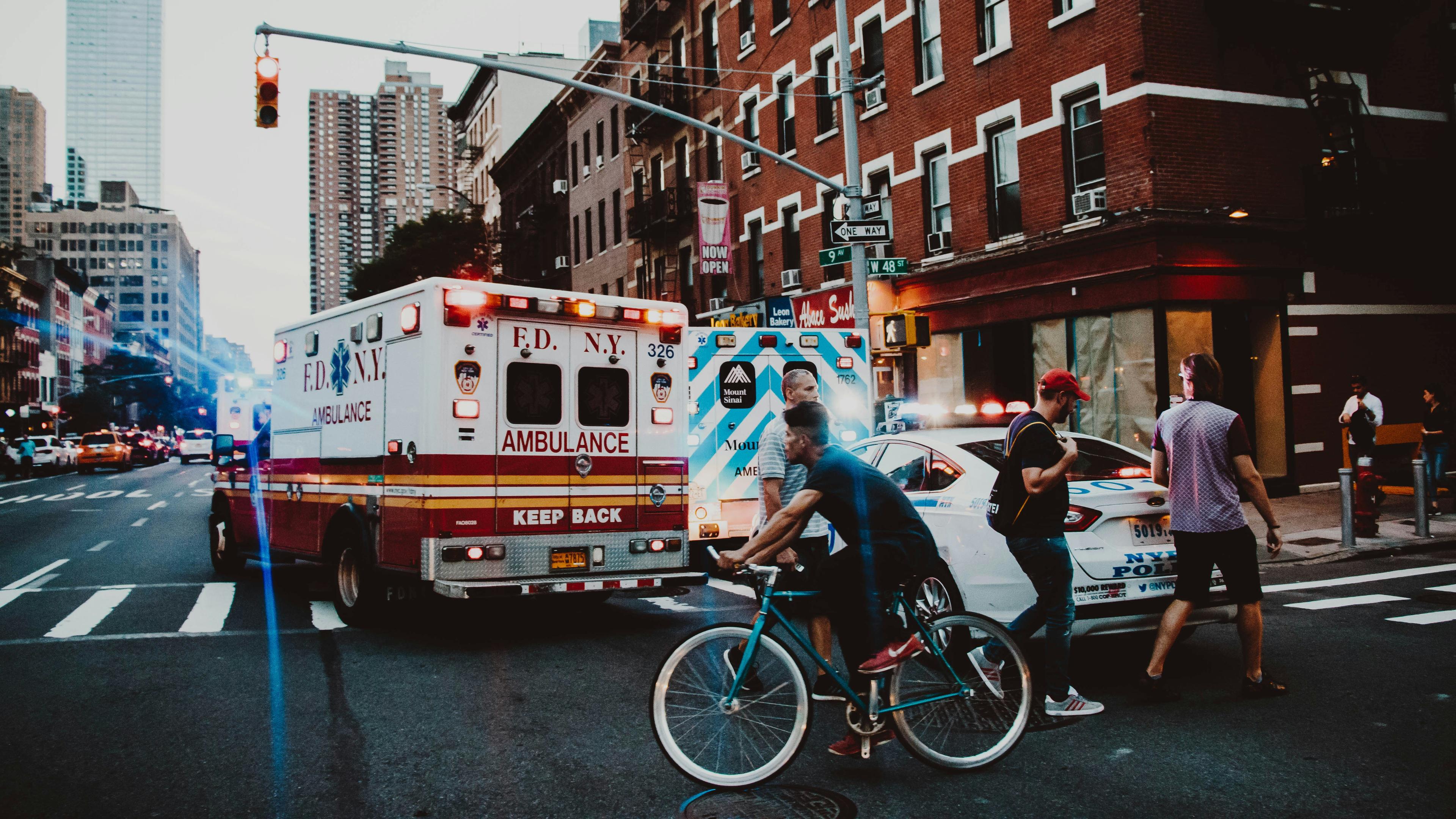
At the corner of 48th and Skillman in Sunnyside, Queens, he went headfirst through a car windshield. His legs were pumping hard to beat the changing light – his curly blond hair trailing behind him as he sped past me.
My heart sank, my knees gave out, and everything started to spin
I was the one waking him every time he lost consciousness. I still hear my own voice: Stay with us. Everyone loves you.
I thought he’d pull through until his body started convulsing. He said something about his legs – the same thing my mother said before she died. My heart sank, my knees gave out, and everything started to spin. ‘Don’t pass out this time,’ I thought.
I knelt beside him and put my hand on his arm. My insides started to shake. My voice cracked so badly I could barely speak.
Then they put him on a stretcher and drove off. I watched the red lights fade into the distance.
I never found out whether he lived or died.
That question lives on in me physically.
Like many with MTS, I never knew I had it. It was just my normal. But the next day, a minister who had been at the scene walked around the neighbourhood asking everyone if I was OK. Did he see something different in my reaction? Are ministers trained to notice these things?
Would I have reacted the same without MTS? There’s no way to know. But call it what you will – no one can deny that it’s empathy.
When I asked the psychologist who downgraded my diagnosis why feeling empathy and having friends leads to a downgrade, he answered:
‘I read it in a book.’
I sometimes wonder if the book was Zero Degrees of Empathy. The one that claimed autistic people lacked empathy, grouping us with psychopaths and serial killers. The one debunked in the UK more than a decade ago.
So I tuck away the idea that mirror-touch synaesthesia might be proof that autism and empathy can coexist – a small reminder for a rainy day that I am autistic and feel deeply, whether it shows or not, downgrade or not.
And no, I don’t have a City-As-School diploma. But I walked away with a nickname and a 50-year friendship with Walter Joseph Weir, Jr. So if I have to choose between a diagnosis and friends, go ahead and downgrade me. As Walter would say, ‘Bring it on.’ And Basquiat throwing a pie in the face of the man who called me a black hole? Priceless. We just keep laughing.