I was a fourth-year medical student just back from an extended leave after the birth of my first child. Baby and baby bag in tow, I met with my advisor, a bow-tied infectious disease specialist, in his cramped office tucked inside a musty academic building. I found him sitting in a rolling office chair behind a bulky mahogany desk, studying my academic records. Sinking into an oversized armchair crammed between the bookcase and the door, I arranged the baby, and myself, and waited.
Maybe it was my addled expression, or the urgent pitch of my voice, that made him pause and look up to take in the scene of me: my ratty sweatshirt stained with baby spit-up, the high ponytail, the baby knocking his head against my shirt, searching for a way to the engorged breast underneath.
I blurted that my re-entry back into clinical rotations had to include a way for me to keep breastfeeding. After a beat, with the calmness of a cowboy approaching an unhinged filly, he suggested I start with a low-key rotation at the local hospice.
This was the late 1990s, and hospice care was still new enough in the United States that it hadn’t yet been fully inculcated into the fundamental teaching of medical students. My stint as a learner there was viewed as extracurricular – not a core experience – the general principle being that doctoring was about saving lives.
From the front, the Connecticut Hospice building looked deceptively like a 1970s suburban office complex, a no-nonsense, three-storey concrete exterior with even rows of oversized, darkly tinted windows. But around back, the building opened into a grassy area with a garden, picnic tables, and a gazebo overlooking Branford Harbor.
My advisor was right about the atmosphere. It was quiet. Inside, fluorescent lighting bounced off mustard-coloured hallways that opened into cheerier patient areas, where rectangles of heavy-gauge, ceiling-to-floor privacy curtains separated hospital beds and side-tables. Staff drifted by in squishy-soled sneakers: a nurse pushed a mobile workstation; social workers and spiritual counsellors met with families; aides in green scrubs and hairnets delivered toothbrushes and clean towels, or wheeled oversized meal carts stacked with lunch trays. All of them absorbed, in their own ways, in the tasks of the day.
I remember a sense of unease walking into the building those first few days, watching ambulances, sirens off, pull up in the circular driveway in front of the hotel-like lobby to deliver new patients, while arriving families went to park the car. Later, I learned there was a discreet exit on one side of the building. That was the one funeral homes used when it was time to depart.
Spending time with the dying without a doctorly purpose required rewiring
My daily routine at the hospice was divided into low-pressure scenarios, hanging out with different clinical staff. In the mornings, I tailed the team – a nurse practitioner, a social worker and a chaplain – as they made rounds from patient to patient, orchestrating pain management plans, family visits and spiritual interventions.
The weeks passed and the nurses gave me a new assignment: ‘Sit with someone.’ No further instructions. I took this as a polite way to get rid of me while work was being done. But gradually I began to understand it as a method, one meant to counter the nascent training as a data collector that had been baked into my thought process during medical school. Spending time with the dying without a doctorly purpose required rewiring. There was no diagnosis to chase.
At first, I was uncomfortable just sitting with someone who was close to death. But, over the weeks, I relaxed, travelling along with them through stories that unfolded between stretches of silence. I understood when to return later to pick up a story that had trailed off in a doze, and to match my tempo to the pace of another’s body as it settled into its final position.
This habit of stillness, from that time at the bedside, without an agenda, became a connective tissue, the thread that ran through my path from medical student to, years later, a palliative care physician.
It was around the third week of the rotation that I started my visits to Mrs C, as I’ll call her. Mrs C’s lung cancer, no longer held in check by chemotherapy, had left her bedridden as it worked its way into her bones and spread like a patina of fine grains across the surface of her lungs.
I joined the physician medical director when he stopped by her bed each day to check on her breathing. During one visit, he commented: ‘It might be time to drain the fluid encasing her left lung.’ Cancer fluid, he explained, had seeped into the space between her chest wall and lungs. I imagined this as the body’s attempt to wash away invading tumours, except that, once the fluid entered that space, it had nowhere to go. It made it hard to breathe, like a straitjacket around the lungs. Most days, the nurses could make Mrs C comfortable by raising the head of her bed, turning up the oxygen, and cocooning her in a sea of pillows to keep her from tipping sideways.
One day, I went to Mrs C for the bedside medical procedure designed to drain the fluid from her straining lungs – hoping to ease her breathing. Mrs C sat upright, still and silent, at the edge of the bed, gathering her nerve. Sensing I was losing mine, she reached out to hold my hand, then nodded, consenting to proceed.
I pressed my stethoscope against her back, suppressing my awkwardness at this moment of intimacy
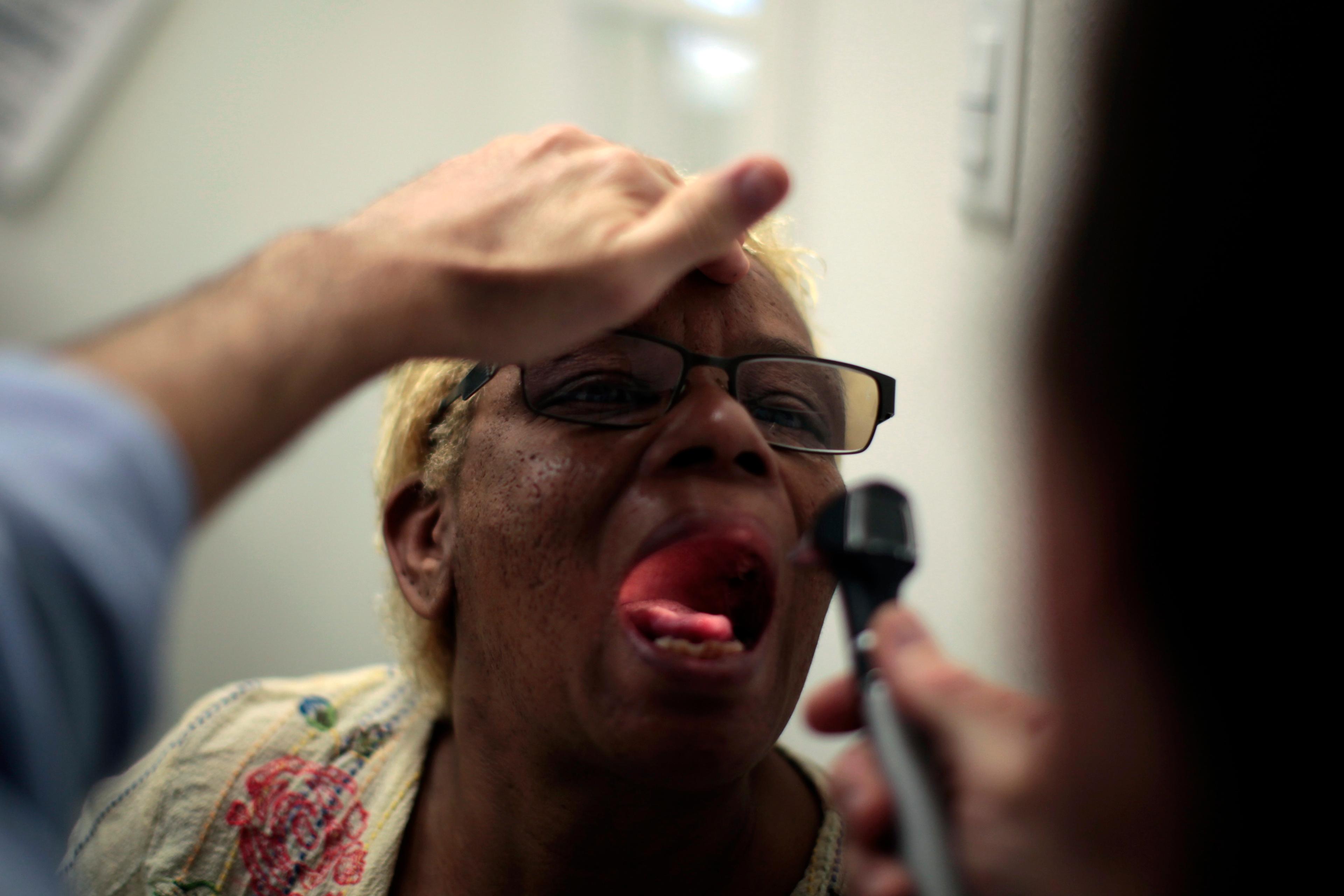
While the doctor set up the kit, I hovered at the foot of the bed, unsure what to do. Mrs C appeared comfortable, wrapped in a crocheted shawl. But when the doctor gently lifted the back of her gown for a close listen to her lungs, his stethoscope oscillated with her heaving breaths like a buoy riding the surf.
‘Listen,’ he instructed me. ‘Start at the top of her back and work your way down to the bottom of her rib cage.’ I caught hold of myself and pressed my stethoscope against her back, suppressing my awkwardness at this moment of intimacy, leaning in closely.
As I moved my stethoscope across her back – right to left, then down, right to left – I heard her breath diminish. What began as the clean swoosh of air moving in and out faded to silence. I knew this was a sign: a fluid pocket dampening her breathing, like the muffling of voices when you dive beneath the surface of a swimming pool.
After finding the spot where the dullness was most pronounced, the doctor inserted a small needle into her chest wall, under a rib. The needle was attached to plastic tubing, which connected to a bottle sitting on the floor. The hope was to drain away her shortness of breath. Gravity pulled, quickly at first and then as a steady drip. A dark yellow fluid filled the collecting bottle. The doctor blocked off the flow at a litre when Mrs C’s breathing became more rapid.
I hadn’t expected her shortness of breath to worsen. The doctor, reacting to my panicked expression, explained that the lung needed time to expand and adjust.
‘Sit with her for a while,’ he said. ‘I’ll check back in a few minutes.’
Mrs C reached again for my hand and smiled weakly, leaning forward, still on the edge of the bed. We sat in silence while her breathing calmed. I took in the peace of the moment, wondering how I had come to find myself here, so close to the dying.
When I asked if I could return in an hour and bring my baby to visit Mrs C, I received a nod of approval from the evening nurse. In the hospital where most of my training took place, the idea of bringing a baby to visit a patient was unthinkable. But here at the hospice, giving over to a moment defined by human warmth felt like a natural part of doctoring.
When I returned, Mrs C looked comfortable but still weary from the procedure. In my absence, the nurses had freshened her up with a clean gown and new bed linens.
I set myself up with a chair pulled close to the head of the bed, my baby still swaddled in a BabyBjörn sling. Mrs C reached out to stroke his head, her eyes brightening, and I imagined a meeting between us in a different situation, without cancer.
I wondered whether she had seen my future – the way someone might when they are close to death
Neither one of us spoke, while Mrs C played with the baby’s toes. We breathed together. I inhaled in all directions, and encouraged her to do the same, still thinking, maybe, I can reteach her lungs to expand.
I pressed my stethoscope to the area of her chest that had been silent. Now, the inhale rose in a cacophony, a rumbling distant storm. I knew then that our intervention might give her a few days of ease, but no more.
When she looked at me, I saw myself through her eyes: my pink flowery shirt billowing over a belly still stretched from pregnancy, my medical student’s white coat. She smiled, and I wondered whether she had seen my future – the way someone might when they are close to death.
A calmness washed over me. It was perhaps her smile that swept away my worries about combining motherhood and doctoring. I could be both, I thought. I didn’t want to lose this moment, so I blinked my eyes like a camera shutter, recording a memory. She leaned toward the baby perched on my knee, and I leaned to grab a bottle.