is an author, speaker, thought leader on intuition and leadership, and executive leadership coach. She is the author of InnSæi: Heal, Revive and Reset with the Icelandic Art of Intuition (2024, 2025), as well as script writer and co-director of the documentary InnSæi: The Power of Intuition (2016).
is an author, speaker, thought leader on intuition and leadership, and executive leadership coach. She is the author of InnSæi: Heal, Revive and Reset with the Icelandic Art of Intuition (2024, 2025), as well as script writer and co-director of the documentary InnSæi: The Power of Intuition (2016).
‘InnSæi’, pronounced ‘in-sy-ay’, is an Icelandic concept that refers to the magnificent, complex, largely incomprehensible but fascinating world that exists within all of us. InnSæi merges two words: Inn, translated as ‘inside’ or ‘into’, and Sæi,derived from the verb ‘to see’ but also evoking sær, the word for ‘sea’. I love the alchemy of words and the way they can help us make sense of things. InnSæi poetically captures the nature of intuition and provides a framework for cultivating it. In this Guide I will show you how.
InnSæi has three meanings: the sea within; to see within; and to see from the inside out. The ‘sea within’ refers to the flow of your unconscious mind: a world of imagination, vision, sensing and emerging that works much faster than the relatively slow, focused mind. To ‘see within’ refers to self-awareness and metacognition: the ability to see inside yourself, to discern intuition from your biases, fears and wishful thinking, and to know when you can rely on intuition and when not. Finally, to ‘see from the inside out’ implies a strong inner compass, which enables you to navigate and create your own path in the ever-changing ocean of life.
In a world characterised by uncertainty, opportunities, speed and ceaseless attempts to numb our senses and hijack our attention, developing your InnSæi will give you clarity, focus and resilience.
I know this all too well myself.
The only way out was in
In my late 20s, I hit a wall, lost direction in life, and descended into darkness. A series of crises brought me to my knees and forced me to connect within, to my intuition, as I had nowhere else to go.
It started when I embarked on my dream career at the dawn of the 21st century, working for the United Nations in war-torn Kosovo, where I managed a small UN agency. Coming to Kosovo after the war was like walking into an open wound. I was determined to give it all I had, knowing that the people who’d suffered war were my priority, and thinking that my wellbeing was not.
You probably know the feeling I had at the time – that sense of overwhelm when faced with an urgent task, thinking that it will be OK, if only you work harder, try better.
In early 2002, I was travelling for work from Kosovo to Kazakhstan when I felt a terrible pain and started to bleed. I didn’t think much of it, took painkillers and went on with work. It was only a couple of years later that I realised I’d had a miscarriage. Instead of this being my wake-up call, I’d just kept ploughing on, deepening my disconnection from my emotions and body.
Soon after, I was in the unique position of having a guaranteed job at the UN for life. But the heavy bureaucracy and hierarchy at the UN in Geneva, Switzerland felt all-consuming. There, I felt my sense of drive and purpose get weaker, and I felt out of touch with the living world. It was as if we were serving a system instead of serving people and the planet.
Not long afterwards, I also started to go through difficulties in my personal life. The accumulated effect began to take its toll on my physical health. But then, in the middle of a turbulent, sleepless period, I experienced a precious moment of clarity, close by the sea near our home in Iceland. I realised deep down that I wanted a different life. I decided to leave my job at the UN: what followed was a period of uncertainty, healing, rehabilitation and finding my InnSæi.
My story about losing hope in life, about my body caving in, to alert me to my disconnection from within, is by no means unique. Many people all over the world have had similar experiences. Perhaps you have too?
Learning how to align with InnSæi and its rhythms meant that the world inside and around me started to move and flow. I had begun the process of healing. Let me share with you four ways that helped me do it.
Key points
InnSæi is an Icelandic concept that poetically captures the nature of intuition and how to cultivate it. InnSæi has three meanings: ‘the sea within’ (your unconscious); ‘to see within’ (self-awareness); and ‘to see from the inside out’ (a strong inner compass). You can find your InnSæi by following four exercises.
Connect with your gut. Mind-body connection is necessary to be able to align with and hone your intuition through InnSæi. To practise, take some deep breaths, try asking yourself questions and see how your stomach reacts to them.
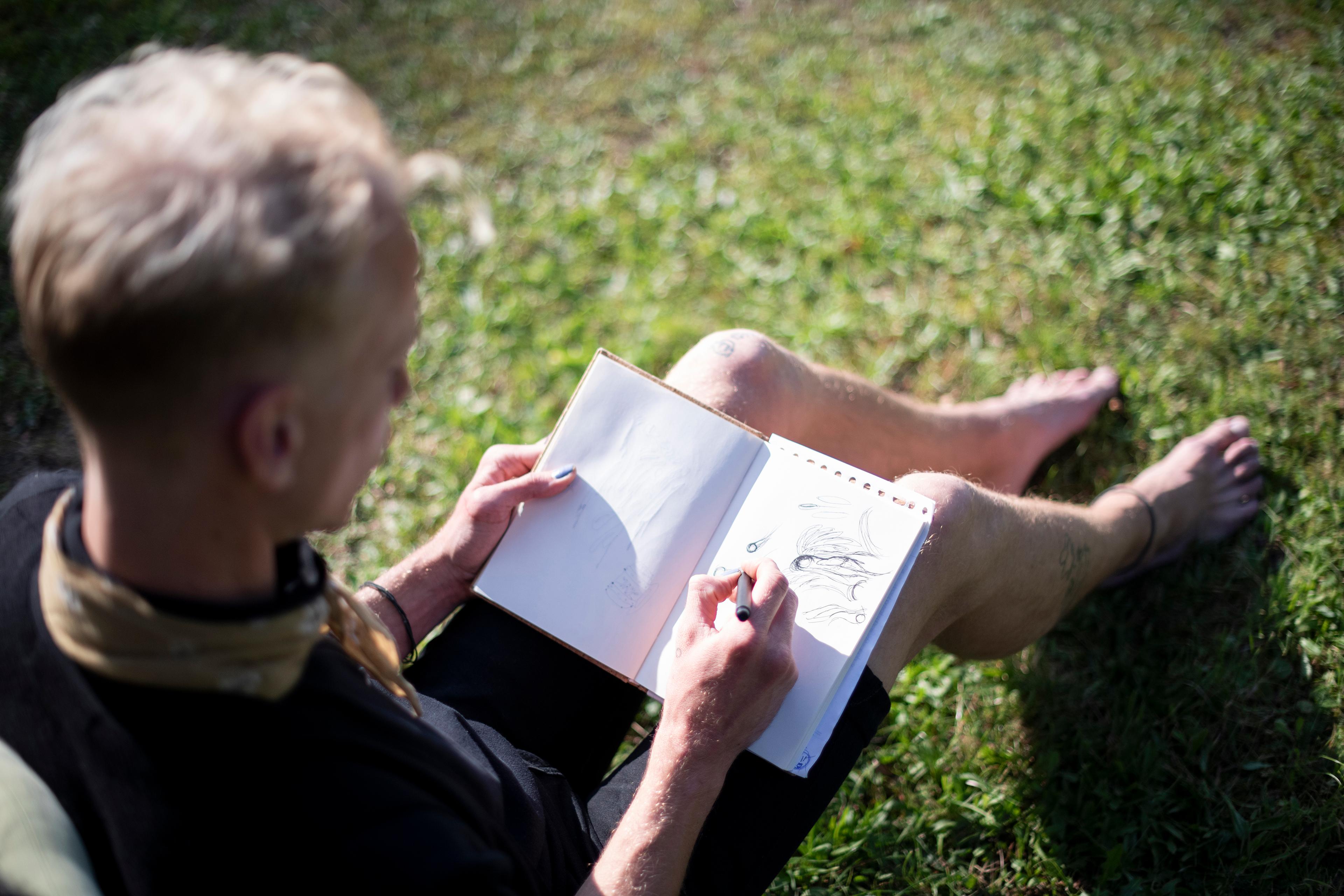
Use journaling for mental clarity. Keep a daily journal each day for 5-15 minutes. Don’t analyse or judge your thoughts. Simply allow them to flow onto the piece of paper. Make sure you also tune in to your body as you write.
Keep an attention journal. Carry your daily journal with you wherever you go and make a note of anything that captures your attention. Paying attention to your attention provides information about what you’re allowing into your system – what’s informing and shaping you, mostly unconsciously.
Cultivate a state of flow. Choose a meaningful, challenging task that you really want to achieve, set aside 60 minutes of private time to focus on it (consider playing instrumental music in the background) and then let your ideas flow. Reflect afterwards on whether you manged to become fully immersed and lost track of time (a sign of flow). What would you do differently next time?
Connect with your gut (the sea within)
Mind-body connection is necessary to be able to align with and hone your intuition through InnSæi. Reading your body’s signals (eg, your ‘gut feelings’) will help you tap into unconscious information: the sea within.
When something feels off, we talk about getting chills down our spine or a gut reaction. That’s your cue to ask: what is my unconscious trying to tell me? Learning how to read your body signals is a matter of constant practice – you are the only one who can become an expert at it.
Take the example of a knot in the stomach. It could have different meanings. It might signify an urge to do something you’ve been postponing, avoiding or are ready to do. Alternatively, a knot in the stomach may be telling you that you are about to do something that goes against your values. Honing your InnSæi will help you tell the difference.
Learn to interpret your body’s signals
Here’s an exercise to help you practise interpreting your gut’s signals. It’s especially good if you are worried, stressed or anxious:
Take a few deep breaths and observe how your breathing moves your stomach. Listen to what your stomach is telling you it needs. Does it want extra-deep breaths? Or does it want a full stretch – extending your feet and spine while expanding your belly?
Ask yourself questions and see how your stomach reacts to them, does it feel calm or anxious? Your questions could be: How are you doing [insert your own name]?Is [insert a decision you’re contemplating] the right choice for me at this point?Am I afraid of [insert a decision or outcome relevant to your situation]?
Next, lie on your back and take two or three deep breaths to settle into the position.
Breathe in deeply, keep the air in and, on the count of four, breathe out until there’s no more to exhale. Now suck in your stomach two or three times in a rhythmic movement, holding in your breath on the last inhale. When you can’t hold your breath any longer, let it all out before filling your lungs with air once again.
Repeat this a few times.
Now write down in your journal (more on this next) what came up for you. Expressing your thoughts in this way, after connecting with your body, will help you process and more effectively reflect on what your unconscious is trying to tell you.
Use journaling for mental clarity (to see within)
Keep a daily journal
Journaling daily, in a stream of consciousness, is a powerful way to reduce mind-chatter and witness yourself unfold. You are ‘asking’ the journal to store a lot of the thoughts that are otherwise floating around in your mind and taking up mental space. That is a goal in itself, and it will help you hone your intuition.
Write for 5-15 minutes. Allow the thoughts and words to flow from your mind. If you miss a day, continue the day after.
Don’t analyse or judge your thoughts. Simply allow them to flow onto the piece of paper. I recommend writing with a pen or a pencil: research shows it is more effective for your clarity and memory than typing.
Journaling helps you better see what type of thoughts are swirling around in your mind and to become more aware of any critical voices in your head. When you journal, it’s important to consciously decide that these voices need to leave your headspace.
Other voices will pop up, too, and it is important to recognise them in order to find your own. We all have stories in our heads, based on old beliefs and assumptions. Some of these beliefs and assumptions may come from loved ones or may even be something you think loved ones would say. When your brain predicts outcomes from old mental models, it reinforces a loop. Your mission is to make a hole in your mental model, step out of your habitual thinking and behaviour, and create space for new visions and ideas.
Journaling can help you unravel unhelpful patterns, realising things like: ‘Oh my God, I’m in a loop. How many minutes a day do I spend on this thought? Is this a recurring fear? Is it someone else’s voice in my head or a genuine gut feeling?’ Over time, you can better differentiate between intuition and other internal signals. You can become more selective about the thoughts you listen to. Make sure you also tune in to your body as you write. Note down when you feel physical reactions to your thoughts. This will build on the previous step about gut feelings and teach you to read your body’s signals.
Keep an attention journal (to see within and to see from the inside out)
Your attention is the key to intuition. You pay attention with your whole body and senses. And as we know, our attention is a scarce resource, and highly sought after in today’s world.
It is important to remain the steward of your own attention, because how you pay attention and attend to the world shapes your intuition, intelligence and the world you experience.
The guiding principle for attention journaling is a simple, yet powerful instruction:
Pay attention to what you pay attention to, and document it in your journal
Make sure you keep your journal with you wherever you go. Attention journaling collects snapshots from your senses, body and mind. (You can use the same journal as for your daily journal practice – don’t worry if the two types of journaling get mixed up.)
Any time something catches your attention, write it down in the journal (either in the moment or, if not practical, then at the earliest opportunity). Don’t judge, simply weigh and evaluate what your attention picks up.
Research shows that our hearts sometimes know before our minds do. Somatic markers like changes in heart rate, gut sensations or muscle tension is our embodied intelligence at work and it often occurs before conscious awareness. By paying attention to what grabs your attention, you will better hear what your intuition is telling you.
Let’s say you’re shopping at the food market and notice the energy of the person beside you at the till. Later, you write in your journal: ‘The energy of the person next to me was …’ You don’t even have to explain it. You just notice it. What we pay attention to brings certain things into life while others recede, but rarely do we notice what we notice. While we could never possibly notice all the information surrounding us at every moment, most of us can do a better job of paying attention to what we are picking up with our mind and bodily attention.
Paying attention to your attention provides information about what you’re allowing into your system – what’s informing and shaping you, mostly unconsciously. It is also a brilliant generator for creativity. It helps wake up sleeping systems, sparks ideas, can bring us joy, and make unexpected connections between seemingly unrelated dots.
There are also various deliberate ways to learn from your attention journaling, here is one:
Choose 10 words or phrases from one week of attention journaling
At the end of a week of writing your attention journal, flip through the pages and choose 10 words or phrases randomly, and underline or highlight them. Don’t worry that the pages mix with the daily journaling.
Now write out those 10 words or phrases in a vertical line on a fresh sheet of paper.
Give yourself time to observe this list and sense what these words tell you. Don’t rationalise them, practise observing them and keeping your mind open for them to speak to you. Here we practise one of the ways to see from the inside out. What emerges for you?
Each word and sense is there because you paid attention to it. Allow patterns, shapes, narrative or a feeling to emerge. Trust the process, let go of control, let the context come to you.
Many of us find it very hard to not control the process, but to allow this raw material to speak to us and for ideas to emerge. The more times you try it, the easier it will become and it will help you tune in to your intuition and sense-making, without being deliberate or having preconceived plans.
For instance, an engineer who studied with me in 2009 found this exercise foreign and challenging to begin with. But after doing it, she came back with a prototype of a ring, which soon became a successful jewellery brand. Some of what her attention picked up was ‘egg shell’, ‘feather’ and ‘a red thread’. She noticed she was always creating something decorative from random things she found in her environment. (Paradoxically, the things that come very naturally to us are often things we do not usually value or notice enough.) Paying attention to what she paid attention to made her realise her artistic inclination and that her way of seeing items and the environment was unique to her.
If by the end of this exercise you have come up with a valuable and interesting insight, you have experienced how intuition can work cognitively, and how intuition and analysis are mutually supportive and synergistic.
Cultivate a state of flow (see from the inside out)
This exercise helps you merge together bits and pieces of all the three dimensions of InnSæi – but especially helps you to see from the inside out. It’s about allowing your intuition to flow and work hand in hand with presence so that you can tap into your inner sense of direction, interest, knowledge, imagination and experience. Each time you perform this exercise, you are disciplining a part of your mind not to get in the way of your ‘flow mindset’. When you are in your zone, in a flow mindset, you lose track of time and self, and feel fully immersed in the act. You are aligned with your intuition and inner compass.
To start, I recommend you set an alarm for 60 minutes, so you can fully focus on the task at hand in private. I personally find it helpful to play instrumental music during the exercise, to help everything flow and release me from the grip of my often overly logical, analytical mind.
Three steps into a flow state:
Choose one task that you really want to achieve. Flow takes all your mental energy, deployed deliberately in one direction, so that’s why it’s necessary to focus on just one goal at a time. It could be writing a presentation, pitching an idea or creating a strategy for something you care about.
Think about why this task is meaningful to you – you can’t flow into a goal that you don’t care about. My work on InnSæi is deeply meaningful to me. At the start of 2025 it had become clear that my book was coming out in many languages around the world. How did I want to continue to work on InnSæi besides the book? Should I write another book? Start to teach at a university? Focus on giving talks? I felt the urge to find a clear focus for my work and my task for the next 60 minutes would be to identify what practical steps I needed to take.
It helps if the task you choose to do is at the edge of your abilities; so try taking what you like doing a step further, make it a bit more challenging. For me, I was doing something new. I had never written a strategy for InnSæi and I was intimidated by the ‘business’ side of it. I downloaded a strategic planning template I found online. I set the alarm for 60 minutes, and I started to fill the template with my vision for InnSæi until 2030. I allowed ideas to flow on the paper – the process was effortless and I enjoyed it. I didn’t stop to think what I was writing, I simply allowed what emerged to flow. I wrote with more courage than I would have had if I’d stopped myself along the way with questions like ‘You think you can do that?’ ‘How are you going to make this happen?’ ‘Shouldn’t you be walking the dog now!?’ At the end of the 60 minutes, I read what I’d written and allowed my analytical mind to make only a few tweaks.
After you’ve practised the flow exercise for a set time, reflect on your experience in your journal. What is your takeaway from practising a state of flow? Did you manage to lose track of time and place and to feel immersed in your activity? Would you have had the same outcome without being in a state of flow? Jot down how the flow state helped you align with your InnSæi and inner compass. What would you do differently next time?
Final notes
In our age of information overload, uncertainty and search for meaning, a well-honed intuition – InnSæi – is crucial to stay consciously and courageously anchored to our inner compass while constantly adjusting to new realities. Realistically, learning how to align with, tune in to and master your intuition and InnSæi takes both intention and discipline – the more often you practise the exercises in this Guide, the easier they will become. If you would like to get to know more about InnSæi and how it is practised among leaders, explorers, artists, philosophers, scientists, healers and people from the world of sports, read my bookInnSæi: Heal, Revive and Reset with the Icelandic Art of Intuition (2024). You might also enjoy our documentary filmInnSæi, the Power of Intuition (2016), available on various streaming services. InnSæi with Hrund Gunnsteinsdóttir is my bi-weekly newsletter.