The word ‘ghosting’, rendered as a verb, has a longer history than you might think. One of the earliest records of the term is from 1637, and describes ‘the action of becoming, or making someone into, a ghost’. Here, ghosting is merely a synonym for murder, or haunting. A similar usage can be found in Shakespeare’s celebrated play Antony and Cleopatra in reference to Julius Caesar, ‘who at Philippi the good Brutus ghosted.’ Throughout the 17th century, ‘ghosted’ could simply mean ‘to die’. In a medical treatise entitled The Art of Curing Diseases by Expectation (1689), we find the melancholy sentence: ‘A day or two after … the Lad having been miserably tortured, Ghosted.’ Interestingly, during the Victorian era, we find a reference to a ‘ghosting system’, in E S Barrett’s novel The Heroine (1813), suggesting a more formalised strategy for scaring people into various schemes. Since at least the turn of the 20th century, ‘ghosting’ has been used to refer to the practice of writing a book in secret, or on behalf of the named author (‘ghost-writing’). Other applications include the second, spectral image on old television sets – ones with less-than-perfect, ghostly reception – as well as the practice of moving inmates from one prison to another, without word or warning.
Closer to our own time, ghosting became a way to describe a person’s sudden departure. This usage was first recorded in the novel Gardens of Stone (1983) by Nicholas Proffitt: ‘Where’s Wildman? If that sad sack is ghosting again, I’ll have his butt on a biscuit for breakfast.’ The first mention of ghosting – in the sense we think of it today – was on Twitter, on 3 April 2007. The esteemed user @Vonster posted: ‘Just now realized I ghosted Gedeon on our interview? Doh!’ In this case, the first contemporary use of the term is used in relation to the world of work (Gedeon being perhaps a reference to a media company, or a pharmaceutical concern), rather than the world of friendships or romance. In the years since, we have come to associate this word with the latter – with love. Indeed, these days, the threat of ghosting haunts would-be relationships before they even begin.
The Oxford English Dictionary definition of ghosting, enshrined in 2012, is as follows: ‘The action of ignoring or pretending not to know a person, esp that of suddenly ceasing to respond to someone on social media, by text message, etc; the action of ending a relationship or association with someone by ceasing all communication.’ Communication technologies are central to this definition. Ghosting thus emerges from the silicon infrastructure of our online world. This distinguishes the latest iteration of ghosting from those of previous epochs, giving it a new haunting ground, so to speak: the virtual, digital realm.
There is something uncanny about modern media. It can effect changes at a distance, summon phantoms on to our screens, connect us across vast distances, and capture ‘reasonable facsimiles’ of ourselves for its own obscure purposes. Since the first voice was captured on tinfoil, or the first likeness captured on silver plate – even our first words captured on papyrus – we have had access to a new type of memory, which the French philosopher Bernard Stiegler called ‘tertiary retention’: an outsourced form of recall, embedded in objects, bits, and bytes. No other form of life has achieved this feat, at least not at the human scale. In the process, we have normalised the ubiquitous, ongoing half-lives of voices long gone, faces long vanished, and thoughts long ceased.
This complete entanglement of the virtual and the actual makes any distinction between absence and presence more complicated than ever before
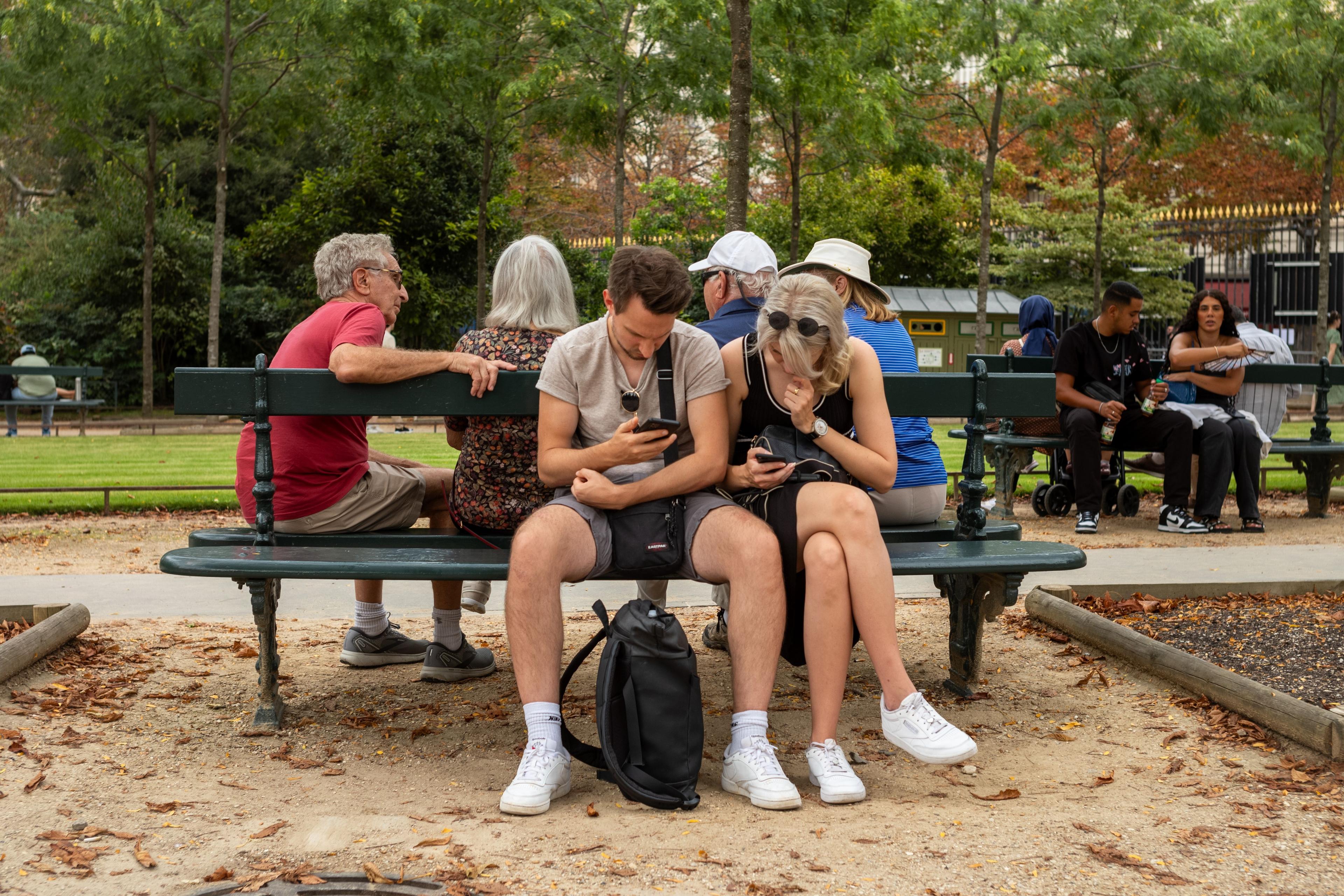
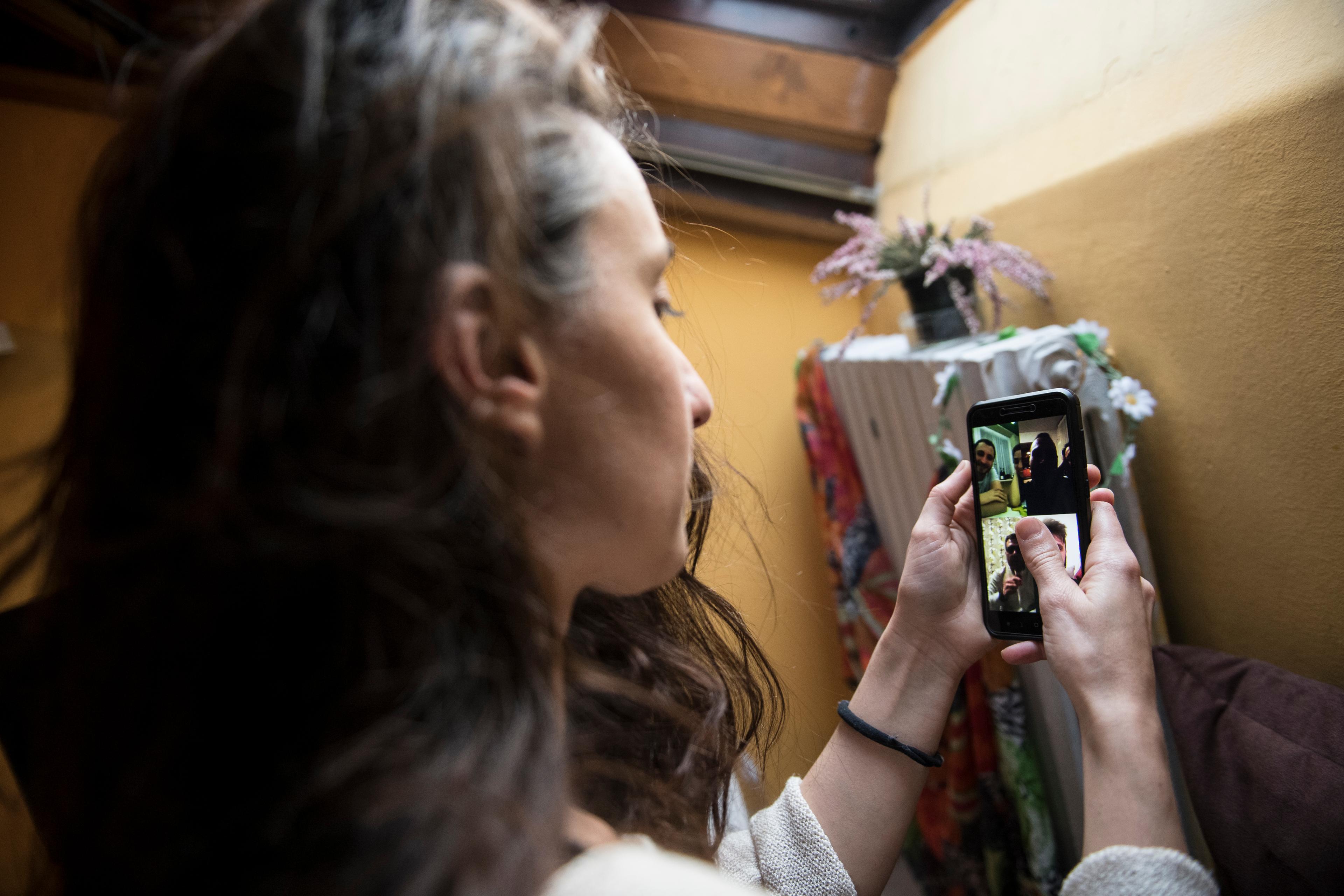
For the novelist Marcel Proust, the telephone was almost a diabolical machine, since it could summon up his beloved grandmother as if she were compelled by a séance; both there, in his ear, but decisively not there, in the room with him. Our smartphone technology has only increased this existential paradox, as we text with people who seem closer than the person next to us on the bus, but who are nowhere to be seen (or heard, or felt). We are, in other words, surrounded by ghosts already, and we’ve invented new types of mediated haunting that are, oddly, more comforting than unnerving. We have introduced a new immaterial, spectral dimension into our affairs. So, it’s no wonder that people slip in and out of our lives more easily – the grooves of departure lubricated by ectoplasmic technologies.
Friends, family, colleagues… they are all a click or a tap away. Dating apps promise to rapture up a new paramour with a single swipe, and social media offer a universe of pseudo-social relationships and interactions. This complete entanglement of the virtual and the actual makes any distinction between absence and presence more complicated than ever before. People can now sustain long-distance relationships for years thanks to smartphones and laptops, while a flesh-and-blood roommate can appear as pale and remote as a ghost.
In the past decade, thousands of articles published by news sites and magazines have decried ghosting, giving voice to those who feel the victim, while also trying to help explain the motivation for the act itself. One question running through these tentative explorations in the popular press is the extent to which ghosting is a symptom of our increasingly isolated lives and to what extent it is, in fact, the root disease itself, leading to further sets of symptoms. To what degree, in other words, is the spectral removal of precious people in our lives a representation of the zeitgeist itself?
Those aspects of life once considered to ‘take a village’ now take an absurdly burdened individual
We live in a time when former support structures and safety nets are swiftly dissolving or being deliberately dismantled. Even the ground beneath our feet is no longer to be simply taken for granted. The Australian environmentalist Glenn Albrecht has coined the term ‘solastalgia’ to describe the new kind of grief created by a new kind of homesickness: one in which home itself mutates beyond recognition due to the ecological changes taking place. Given the universal experience of aggravated precarity, it is no surprise that we become increasingly white-knuckled as we cling to the things that give us some semblance of security, whether that be a job, an ideology, a friend, a lover, a pension plan, or a companion animal. The ambient insecurity of contemporary life, enabled and encouraged by nearly half a century of neoliberal economic policies, means that a sudden absence or withdrawal from our fragile ‘support system’ hits harder than ever.
Margaret Thatcher reportedly said: ‘There is no such thing as society’ – a statement that essentially inaugurated an age in which ‘the people’ would be ghosted by something so obvious and taken-for-granted that its persistence was never even considered: society itself. And yet that surreal situation is what we are living through today. The rapid ‘transformation of intimacy’ – as the sociologist Anthony Giddens put it in the 1990s – that followed the arc of the 20th century meant that small-scale relationships, especially in the form of the heterosexual couple, were increasingly tasked with taking on all those modes of support that we would normally associate with a small town. One’s partner was essentially retrained to be lover, friend, counsellor, colleague, cook, housekeeper, personal assistant, chauffeur, cheerleader, patron, nurse, shrink and everything else besides. Those aspects of life that were once considered to ‘take a village’ now take an absurdly burdened individual. No wonder one’s ‘life partner’ so rarely lasts for life, the resulting wrinkle being that people become more and more dependent on fewer and fewer souls, leading to more and more pressure, which in turn creates the ideal conditions for seeking to break free. It’s a shrinking, vicious cycle.
‘Why?’ is the refrain we all feel deep in our bones when someone has ghosted us. What did we do to warrant – or even authorise – such behaviour? How is it that we weren’t given an opportunity to apologise, to mend our ways, to make amends? Ghosting leaves the ghosted one (or ones) grasping at straws to explain why they deserved to be abandoned.
We have all been ghosted. Indeed, most of us have probably ghosted somebody in turn. We may wince and grieve over such abrupt partings, or we may simply shrug, rationalising such behaviour as an inevitable byproduct of an overly social and overburdened world. Indeed, given the number of personal connections we are obliged to maintain in modern times, it is no surprise that some of these relationships will become burdensome. The easiest option may be to simply let some of them fall by the wayside. Like spinning plates, some relationships inevitably crash to the ground.
And it does appear to be inevitable. The sociologist Robin Dunbar even suggested a specific figure corresponding to the maximum number of people that the average person can interact with in any meaningful, reciprocal sense. That number is 150. Beyond this figure, we ostensibly cannot maintain friendships or collegial ties with any true traction, and things dissolve into empty gestures. But this isn’t the only reason for ghosting.
Is ghosting any worse than clinging on to relationships that are already, for all intents and purposes, dead?
Given the limited bandwidth in our own lives (which seems to shrink in direct inverse ratio to the exponential growth of our modem’s bandwidth), a lot of our past considerations for the feelings of others are likely to be sacrificed to the new gods of convenience, efficiency, scalability, and profitability. We will need to develop thick new skins and lowered expectations to absorb the shocks of frequent, transactional affronts and offences. Ghosting, in other words, is well on its way to becoming a normalised form of behaviour, already being explained away by gender politics, neurological difference, and new social imperatives.
While the idea of omnipresent ghosting may sound dystopian, we might also look at the status quo with fresh, unsentimental eyes. Consider relationships from the time before the conquest of dating apps. For instance, it has not been uncommon to ghost or be ghosted by one’s spouse, even while remaining married. In such cases, the post-love couple remain sharing the same house, both haunting the other by a kind of spectral-fleshy absent-presence, with habit, apathy and inertia replacing passion and romance. Is ghosting any worse than clinging on to relationships that are already, for all intents and purposes, dead? Is ghosting any worse than ‘zombieing’, in which former friends and lovers – even family members – send each other an email once a year, for purely ceremonial reasons?
We are all indeed vulnerable to ghosting – just as we are all obliged to ghost on occasion – because contemporary life involves a dizzying amount of quasi-social connections in order to simply hustle up one’s basic needs. To maintain them all with any kind of care or attention is impossible in the age of 24/7 living when even our personal, private time has been commodified, monetised, and industrialised.
‘Ghosting’ is quickly becoming a universal, even banal, experience: an inevitable part of the capricious and promiscuous libidinal landscape. The plethora of new modes of communication has invited an unprecedented menu of options for ignoring messages from others. And, just as we inevitably invented the car crash when we invented automobiles, we also created ghosting when we created the internet. That’s to say, when we came up with texting, we also came up with not texting.
This essay was adapted from Ghosting (2025) by Dominic Pettman, published by Polity.